
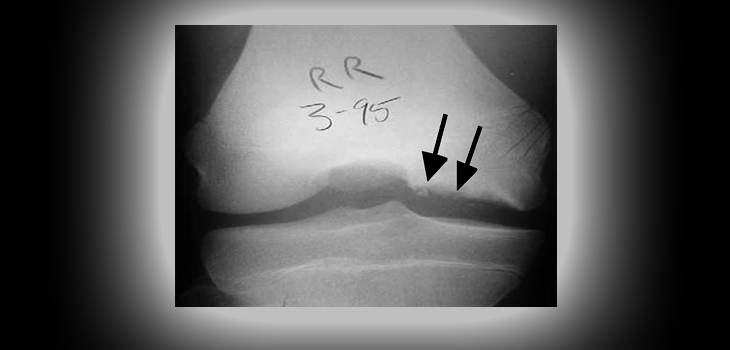
A new population-based study from Mayo Clinic has found that when it comes to osteochondritis dissecans (OCD) lesions of the knee, there is a trend toward increased incidence in this condition in younger males, as well as a decrease in surgical management in females over the last 10 years.
Mayo: Knee OCD on the Rise in Young Males?
3 min read Premium comments
Secondary
The study, “Incidence of symptomatic osteochondritis dissecans lesions of the knee: a population-based study in Olmsted County,” was published online July 12, 2017 in Osteoarthritis and Cartilage.
Ayoosh Pareek, M.D. is an orthopedic surgery resident at Mayo Clinic and lead author on the study. Dr. Pareek told OTW, “OCD is still relatively rare, but due to the limitation in healing potential in hyaline cartilage, they can be an important source of increased progression to osteoarthritis and disability in young patients.”
“To our knowledge, only two prior studies have explored epidemiological incidences of knee OCD lesions, with a third study examining these lesions from ICD codes in a limited insurance population. While these studies have laid foundational groundwork on the incidence of knee OCD lesions, they have also highlighted multiple limitations. Both of the older studies have small populations (less than 200 people in each) with no follow-up over time. This limits examination in trends of OCD lesion incidence along with how lesion management has changed over time.”
“In the current study, the overall age- and gender-adjusted annual incidence of knee OCD lesions (6.09 per 100,000) was much higher for males compared to females, a finding similar to other studies.”
“Still, our study focuses in on a narrow age range, 11-15 years, in which males and females are most at risk for presenting with OCD lesions. This is likely due to a multifactorial reason, such as increased micro-trauma along with activity participation. Moreover, we discovered an increased in incidence of OCD lesions in males aged 11-15 years from 1977-1985 to 2006-2014. This was expected as increased recognition and access to advanced imaging modalities may play a role in increased diagnosis.”
“Surprisingly, the incidence in males 16-20 years saw a decrease in incidence of over the same time frame. This may be attributable to a corresponding increase in diagnosis in a younger population, but warrants further study.”
“Additionally, surgical management in females decreased over time in this study. This may be because the small subset of females in our study had a lower level of activity and therefore less unstable lesions, or that they presented at a younger age. In the latter case, studies have shown nonoperative management in younger patients to have better outcomes over time (in terms of return to activity and radiographic healing) compared to older counterparts.”
“Our study also examined the trends of surgical management and reported that overall, rates of surgical management remained statistically similar in males over time (62.5% to 78.2%). Though statistically similar, since these subgroups were underpowered, we have reason to believe with more patients, our study would show increased surgical treatment over time due to the advent of novel cartilage restoration techniques (such as osteochondral autograft transfer and osteochondral allograft) that allow for direct transfer of hyaline cartilage to previous areas of OCD lesions.”
“Recent studies, such as one from our group at the Mayo Clinic, have shown up to 50% rates of arthroplasty in patients with OCD lesion excisions at 30 years follow-up with even with higher rates of symptomatic arthritis.”
“Therefore, it is the duty of current surgeons to recognize and treat this condition properly. In the same study, it was shown that preservation of the OCD lesion may decrease the rate of arthroplasty to 11% at 30 years and in such cases, an ounce of prevention of an osteochondral defect through earlier recognition may be rewarding to the patients we treat. Further studies examining long-term trends in OCD lesion surgical and nonsurgical management will be essential to elucidating the standard of care for our patients before novel and durable cartilage restoration therapies take effect over the next few decades.”
Author
React:
Discussion
This is a fascinating development. In my practice we've seen similar outcomes with the revised protocol. The key differentiator seems to be patient selection criteria. Has anyone else noticed the correlation with BMI thresholds?
Great point. I'd push back slightly on the conclusion, the sample size in the cited study is too small to draw population-level inferences. That said, the directional signal is compelling and worth a larger RCT.
We implemented a similar approach last year. Early results are promising but we're still gathering 12-month follow-up data. Happy to share our protocol if anyone is interested.
Join the conversation
Orthopedic professionals are discussing this. Sign in and upgrade to read every comment and add your voice.