
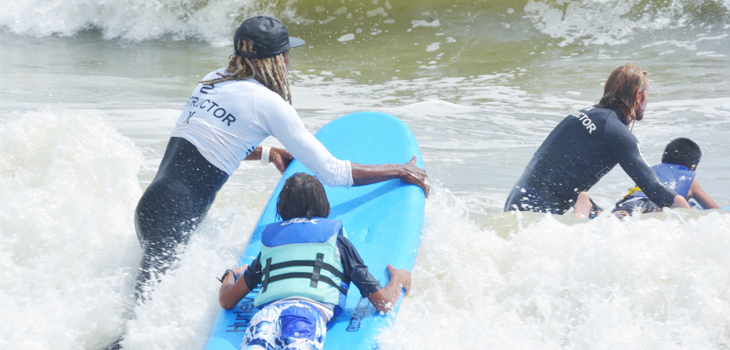
The Hospital for Special Surgery (HSS) recently made waves when it hosted its first adaptive surfing trip on Long Beach for some of its young patients.
Making Waves: HSS Hosts First Adaptive Surfing Trip
2 min read Premium comments
Secondary
According to a news release, 17 patients, most with cerebral palsy or another condition that affects body movement, muscle control, posture and balance, got to hit the waves courtesy of the Adaptive Sports Academy at the Hospital for Special Surgery’s Lerner Children’s Pavilion in New York City.
“The academy organizes trips and recreational experiences for pediatric patients to build their self-confidence, encourage independence, and increase physical activity and mobility,” said Siobhan Clarke, PT, DPT, PCS, a pediatric physical therapist at the hospital who also surfs and owns a home in Long Beach in the release.
Adaptive surfing is a way for people with disabilities to experience the exhilaration of riding the waves. Adaptive sports where sometimes rules or equipment is modified to meet the needs of the participants can be both competitive and recreational.
“Adaptive sports not only enable people to experience the benefits of exercise. They always feel empowered after trying a new activity and succeeding,” Clarke said.
The hospital program is offered without cost, funded by the generosity of donors and sponsors. Patients on the trip ranged in age from 5 to 21. Many have had multiple surgeries by pediatric orthopedic surgeons at Hospital for Special Surgery and have been patients for years.
Sidorela Lleshi, a 21 year-old college student, was one of the patients who participated in the trip.
“It was thrilling…the water was so cool. My muscles are tight, and sometimes I have spasms, but it felt like they loosened in the water,” she said in the release.
Another patient, 12 year-old Aidan Conroy, was hesitant before riding his first wave, but by the end he couldn’t get enough of it.
Each patient surfed with an instructor. World-class surfers Will and Cliff Skudin along with their staff at Skudin Surf provided the lessons.
“Outings such as this are a wonderful opportunity for the kids to socialize with other patients and accomplish things they didn’t realize they could achieve,” says Peyton Katz, CCLS, pediatric patient and family care coordinator at HSS in the release.
“Some kids are not sure at first how well they’ll do, but they always exceed their own expectations. Some parents cry when they see what their child can accomplish.”
Lisa S. Ipp, M.D., chief of Pediatric Medicine at Hospital for Special Surgery, added, “The Adaptive Sports Academy gives our patients a chance to develop new skills and interests, and it promotes mobility and activity. It also reinforces therapy goals by engaging participants in a new activity and requiring them to use their bodies in a new way.”
Author
React:
Discussion
This is a fascinating development. In my practice we've seen similar outcomes with the revised protocol. The key differentiator seems to be patient selection criteria. Has anyone else noticed the correlation with BMI thresholds?
Great point. I'd push back slightly on the conclusion, the sample size in the cited study is too small to draw population-level inferences. That said, the directional signal is compelling and worth a larger RCT.
We implemented a similar approach last year. Early results are promising but we're still gathering 12-month follow-up data. Happy to share our protocol if anyone is interested.
Join the conversation
Orthopedic professionals are discussing this. Sign in and upgrade to read every comment and add your voice.