
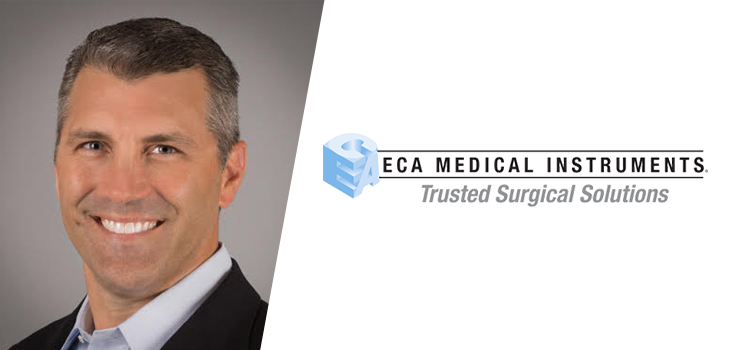
Lane Hale, who has been in the medical device industry since 2005, has been named the new President and Chief Executive Officer of ECA Medical Instruments, located in Thousand Oaks, California.
Lane Hale: New President, CEO of ECA Medical Instruments
2 min read Premium comments
Secondary
As the company wrote in its August 9, 2017 news release, “Hale joins ECA from Surgical Frontiers, where he was Executive Vice President and helped launch and operate start-up medtech companies to develop advanced surgical technologies focused on improving surgical outcomes.”
“In the medical device industry since 2005, he spent much of his career partnering with many of today’s leading medical device companies developing new technologies, launching new products, and sustaining manufacturing. Hale has held leadership roles in business development, operations, and finance at Surgical Frontiers, Insightra Medical, CoorsTek Medical, IMDS and MedicineLodge.”
“Hale has worked in investment banking for Goldman Sachs and in management consulting focused on process improvement. He received a B.A. and M.B.A. from Brigham Young University.”
“Over the past four months, ECA’s Board led an extensive CEO search which included dozens of candidates, and Lane was the Board’s top choice given his experience, background, and personality,” said Rick Rees, Chairman of the Board. “The Board is absolutely confident that Lane is the right leader to guide ECA through its next chapter of transformation and growth. With Lane as CEO, ECA is poised to capitalize on an incredible market opportunity and solidify its first mover advantage and leading market position designing and manufacturing orthopedic and spine disposable instruments and sterile-packed instrument sets. We could not be more excited for Lane, ECA, and our customers.”
Lane Hale told OTW, “For most of my career, I have been in both product innovation and manufacturing. ECA has been leading the movement towards single-use instrument and sterile kits—having expertise in both product development and manufacturing is critical. During my time at MedicineLodge, IMDS [Innovative Medical Device Solutions] and Surgical Frontiers, I have worked closely with most of the leading orthopedic implant companies’ product development, marketing, and operations teams as well as with top design-oriented surgeons to design, develop, and supply next generation orthopedic technologies. From these experiences, I understand our customers’ challenges, needs, and where their opportunities lie. At ECA, we want to be their strategic partner for both legacy and new products that generate additional revenue, reduce costs, and improve patient safety, but also for a one-stop solution for ongoing supply of these new product lines.”
Asked what from his banking experience will be especially helpful, Hale commented to OTW, “Certainly the obvious is the financial acumen developed working at Goldman Sachs. Before actually working with clients and post-MBA, we went through a tough eight month training, development and, I would call, a weeding out process (there was maybe 50% of hires all from top business schools remaining after the first year). However, what I think is less obvious, is that at Goldman Sachs, we worked with some of the world’s most successful and demanding individuals and institutions. They expected a high level of performance and integrity from us. At ECA, we also work with clients and in an industry that demands the highest level of performance and integrity…I would say even more so, as we are dealing with individuals’ health and well-being. Like at Goldman, we will strive to meet the highest standards and exceed our client’s expectations of us.”
Author
React:
Discussion
This is a fascinating development. In my practice we've seen similar outcomes with the revised protocol. The key differentiator seems to be patient selection criteria. Has anyone else noticed the correlation with BMI thresholds?
Great point. I'd push back slightly on the conclusion, the sample size in the cited study is too small to draw population-level inferences. That said, the directional signal is compelling and worth a larger RCT.
We implemented a similar approach last year. Early results are promising but we're still gathering 12-month follow-up data. Happy to share our protocol if anyone is interested.
Join the conversation
Orthopedic professionals are discussing this. Sign in and upgrade to read every comment and add your voice.