
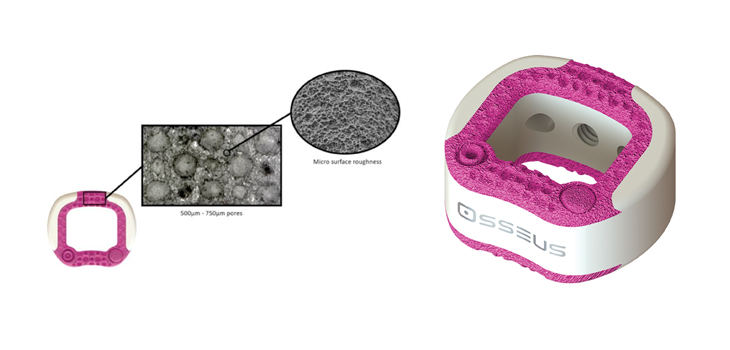
On July 3, 2017, the FDA cleared Osseus Corporation’s new cervical interbody hybrid composition implant which incorporates rough, porous titanium with the radiolucent and biomechanical properties of PEEK. The newly commercialized implant is indicated for intervertebral body fusion procedures in skeletally mature patients with degenerative disc disease at one or two contiguous levels within the cervical spine.
FDA Clears Osseus’ Cervical Implant
2 min read Premium comments
Secondary
Eric Hansen, chief executive officer of Osseus, commented to OTW, “During the building days of Osseus Fusion Systems, we had to bootstrap our way up as a self-funded, no venture-capital organization that consists of myself and my partner, Robert Pace, as well as a lean staff of six, three of which are engineers.”
“We wanted to compete in the 3D-printed and injection-modeled arena like other large companies, but both processes seemed out of range for many reasons. I am proud to say that in this very crowded industry, we have developed a product that is extremely unique. As we gathered our surgeon development team of orthopedic and neurosurgeons, our target was to create a robust fusion bed built from titanium to blend with PEEK allowing maximum radiolucent visualization.”
“During the design process of Gemini-C, we came up with many iterations and prototypes. We finally ended up with a proprietary way to blend and connect the two materials, avoiding the expensive prices of injection molding. The process and product that we invented will not shed or leach like many of the companies that are working with a post process and spray on method.”
“Since then we have forged our way into the 3D printed arena by hiring young, but sophisticated engineering minds that have experience with two of the top five national spine companies.”
“Osseus Fusion Systems is extremely focused on the engineering aspect of the organization. Our core focus is to create a broad product portfolio with new and exciting disruptive technologies within the spine implant industry. I believe entirely that this industry survives and thrives on small companies like Osseus to accelerate evolution and to create and develop new cutting-edge technologies.
“This industry has always depended on the ‘little guys’ for ingenuity and speed to market. I learned this with my first company, Surgical Dynamics, and my mentor, Henry Klyce, as we developed the Ray Threaded Fusion Cage. With the next venture, Blackstone Medical, I realized that the larger companies could not follow the path of evolution as quickly as a small, nimble private company could. I’ve come to find this to be extremely valuable to the industry. Our mission at Osseus is to create a team of inventive, entrepreneurial-spirited surgeons and engineers that can expedite and advance technologies while developing superior quality implants and equally important instruments.
Commenting to OTW on the future, Hansen noted, “Osseus will remain private with zero outside investment. Rob and I have managed to get over the hump with our own personal investment of over five million dollars. We are now running at a very sweet 38% EBITA, of which more than 80% of profit goes back into the company that allows us to fast track our product development queue. As we look to the future of this industry, we emulate and receive coaching from private companies like Arthrex and Reinhold Schmieding. We continue to have enormous faith that a privately-owned company can continue to survive and thrive in today’s spine market.”
Author
React:
Discussion
This is a fascinating development. In my practice we've seen similar outcomes with the revised protocol. The key differentiator seems to be patient selection criteria. Has anyone else noticed the correlation with BMI thresholds?
Great point. I'd push back slightly on the conclusion, the sample size in the cited study is too small to draw population-level inferences. That said, the directional signal is compelling and worth a larger RCT.
We implemented a similar approach last year. Early results are promising but we're still gathering 12-month follow-up data. Happy to share our protocol if anyone is interested.
Join the conversation
Orthopedic professionals are discussing this. Sign in and upgrade to read every comment and add your voice.