
There is another option for severe, unstable and comminuted distal radius fractures, says new work published in the August 2017 edition of Clinical Biomechanics.
Bracing vs Casting for Distal Radius Fractures
2 min read Premium comments
Secondary
The study was entitled, “Radiographic evaluation of acute distal radius fracture stability: A comparative cadaveric study between a thermo-formable bracing system and traditional fiberglass casting.”
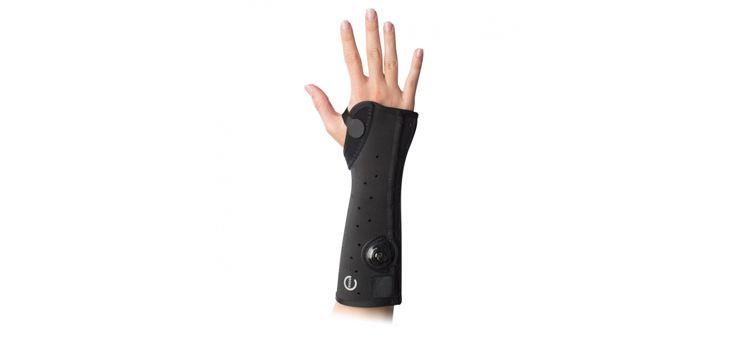
The thermo-formable bracing system used in the study was DJO Global’s Exos Upper Extremity bracing system.
Ann Davis, product manager for Exos Upper Extremity bracing system commented on the study to OTW saying, “Distal radius fractures are one of the most common musculoskeletal injuries in the U.S. and no data existed prior to this study comparing stabilizing efficacy of bracing to fiberglass casting.”
“The Exos technology was developed for management of these types of fractures and we wanted to confirm stabilization capabilities through research that the Exos thermo-formable bracing products were equivalent to traditional fiberglass casting.”
“The study was done by the Foundation for Orthopaedic Research and Education, in Tampa, Florida using a very high level of engineering and detail throughout the study. A worst-case distal radius fracture was created using six cadaveric forearms that resulted in a comminuted extra-articular and unstable distal radius fracture. This type of fracture would likely be managed by surgery, however, we opted for a severe worst case and highly unstable fracture model to delineate any differences in stability between both casting and bracing interventions.”
“We chose fiberglass casting to compare to the Exos brace due to its lighter, more durable, porous characteristics compared to traditional plaster casts and also due to the fact it is a common treatment in the setting of conservative care.”
“The fracture model was verified as being unstable by applying 4.5N of load in the non-stabilized condition. There was an average rotation of 12.3° and an average translation 5.3mm of the fracture fragment proving that the model was unstable under loading conditions. Fragment rotation with the brace (0.0°) and cast (0.1°) significantly reduced sagittal plane rotation compared to the non-stabilized forearm (12.3°) (P < 0.001). The brace and the cast provided similar stabilization in both rotation and translation at all 4 loads. There was no statistical difference in between treatment types in either measurement at all four loads applied.”
“This study demonstrated that both the Exos thermo-formable brace and fiberglass casting successfully stabilized fracture fragments in severe, unstable and comminuted distal radius fractures and provides verification that the Exos thermo-formable braces are a viable option for treatment of these types of distal radius fractures.”
“The Exos re-formable bracing may be advantageous to fiberglass cast application in the setting of conservatively managed distal radius fractures, offering the opportunity to mold and re-mold the brace to ensure patient comfort and mitigate any pressure-related problems with casting, while at the same time providing adequate stability when worn by the patient. To ensure compliance, there is an optional Boa Locking Ring accessory that prevents un-prescribed loosening or removal.”
“The Exos thermo-formable bracing products offer many features and benefits to the patient from the ability to adjust to swelling and atrophy, continue daily activities, such as showering and swimming, and can be easily cleaned to reduce odor and improve hygiene. The thermo-formable bracing products are easy to apply, offer a comfortable warm application process for the patient, requires only one brace throughout treatment and saves the clinician time allowing them to see more patients.”
Author
React:
Discussion
This is a fascinating development. In my practice we've seen similar outcomes with the revised protocol. The key differentiator seems to be patient selection criteria. Has anyone else noticed the correlation with BMI thresholds?
Great point. I'd push back slightly on the conclusion, the sample size in the cited study is too small to draw population-level inferences. That said, the directional signal is compelling and worth a larger RCT.
We implemented a similar approach last year. Early results are promising but we're still gathering 12-month follow-up data. Happy to share our protocol if anyone is interested.
Join the conversation
Orthopedic professionals are discussing this. Sign in and upgrade to read every comment and add your voice.