
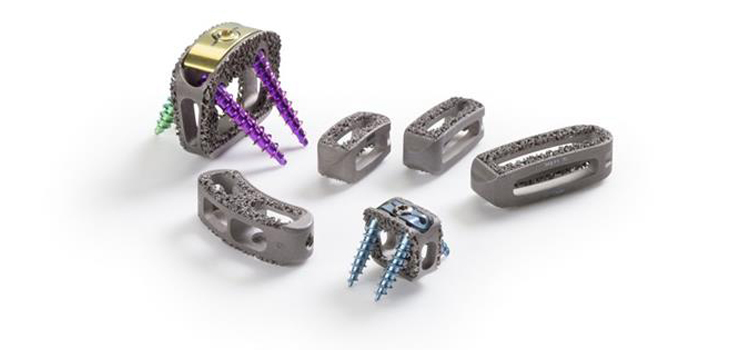
The FDA has granted 510(k) clearance to Renovis Surgical Technologies, Inc. to market its posterior lumbar Tesera porous titanium interbody fusion systems.
3-D Posterior Lumbar System Cleared for U.S. Sales
2 min read Premium comments
Secondary
An August 11, 2017 company press release stated that the systems feature “implants for direct posterior (PLIF) or transforaminal (TLIF) approaches in both straight and curved options.” Multiple heights, widths and lengths are available to fit varying patient anatomies.
All Tesera implants are produced through additive manufacturing (3D printing) and the company’s proprietary Tesera Trabecular Technology, a highly porous structure that allows for bone attachment to implant surfaces and the potential for biologic fixation deep into the pore structure for long-term stability. The structure is highly porous, with an average pore diameter of about 500 µm. Pores of this size reportedly accommodate bone in-growth and the vascularization required to sustain living bone.
The production of the Tesera structure is enabled by electron beam manufacturing (EBM). With the EBM process, devices are built up layer-by-layer, allowing the repeatable production of complex geometries not possible with other manufacturing methods.
“Roughened titanium alloy has been used clinically for more than 35 years and remains the gold standard for bone on-growth.” The company reports that a “study of bone in-growth into Tesera technology bone plugs was conducted in a sheep femur model and had the following results:
- No implant-associated adverse effects on the host bone
- Excellent new bone formation
- Bone remodeling within and adjacent to the porous structure”
“In laboratory testing of the Tesera structure on cancellous bone, the company claims the coefficient of friction was substantially improved over plasma-strayed coating and better than a contemporary highly porous tantalum structure. A higher frictional coefficient enhances initial stability and promotes ingrowth by limiting micromotion at the bone-to-implant interface.”
According to the company, this is the fifth product group featuring the Tesera porous titanium structure for which Renovis Surgical has received FDA clearance. First was the Tesera SA system for stand-alone anterior spinal fusion cleared in October 2013. Then the Tesera acetabular system for total hip reconstruction cleared in April 2014. Followed by the first-generation Tesera posterior lumbar interbody family cleared in March 2015, and the Tesera SC system for stand-alone anterior cervical fusion cleared in March 2016.
The company is headquartered in Redland, California, with an additional office in Austin, Texas. John Steinmann, DO, is the company’s president and CEO.
Author
React:
Discussion
This is a fascinating development. In my practice we've seen similar outcomes with the revised protocol. The key differentiator seems to be patient selection criteria. Has anyone else noticed the correlation with BMI thresholds?
Great point. I'd push back slightly on the conclusion, the sample size in the cited study is too small to draw population-level inferences. That said, the directional signal is compelling and worth a larger RCT.
We implemented a similar approach last year. Early results are promising but we're still gathering 12-month follow-up data. Happy to share our protocol if anyone is interested.
Join the conversation
Orthopedic professionals are discussing this. Sign in and upgrade to read every comment and add your voice.