
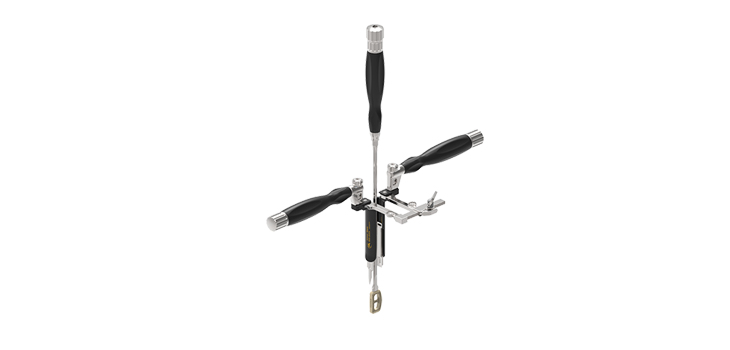
Altus Spine, headquartered in Newtown Square, Pennsylvania, has announced that the U.S. Patent and Trade Office (USPTO) has issued a new patent for Altus’ Imola Lateral IBF (interbody fusion) system.
U.S.P.T.O Issues Patent for Altus’s IBF System
1 min read Premium comments
Secondary
“The Imola System represents a unique advance in lateral access surgery with a one-step retractor-to-frame set up,” notes Charles Goodwin, M.D., associate attending surgeon at Hospital for Special Surgery, in the June 28, 2017 news release. “This saves time and eliminates repeated retractor insertions that can cause irritation to surrounding muscles and nerves. The patented system includes biconvex implant options that fit anatomically with the biconcave vertebral bodies.”
Gary Fantini, M.D., associate attending surgeon at Hospital for Special Surgery, states “The Imola IBF System constitutes the next generation in lateral lumbar interbody fusion. Proprietary frame-to-blade technology permits rapid and safe localization of the target disc under direct vision, limiting operative time, and reducing neurologic sequelae and cost.”
“We are very proud of our accomplishments with Imola,” says Michael Fitzgerald, company chief executive officer and co-inventor. “We knew that we would need to reassess every stage of lateral access to best accommodate this new approach, so Altus engineers coordinated with nationally recognized surgeons; the result of this collaboration is the Imola IBF System.”
Fitzgerald told OTW, “The ‘598 patent continues to highlight Altus Spine’s dedication to working with KOL surgeons to advance surgical technologies in patient care. Altus’ expertise in engineering and manufacturing provides a key element to inventor surgeons needing a technology partner.”
“The ‘598 patent is a culmination of years of clinical and developmental work. The inventor surgeons came to Altus with a clinical technique that was well-established but with no ability to create the surgical instruments needed to optimize the technique’s potential. Altus worked closely with the inventor surgeons and produced the approach and access instruments that they requested.”
“Altus Spine intends to provide continued surgeon training programs, technique labs and expanded surgeon support for this innovative access technology.”
Author
React:
Discussion
This is a fascinating development. In my practice we've seen similar outcomes with the revised protocol. The key differentiator seems to be patient selection criteria. Has anyone else noticed the correlation with BMI thresholds?
Great point. I'd push back slightly on the conclusion, the sample size in the cited study is too small to draw population-level inferences. That said, the directional signal is compelling and worth a larger RCT.
We implemented a similar approach last year. Early results are promising but we're still gathering 12-month follow-up data. Happy to share our protocol if anyone is interested.
Join the conversation
Orthopedic professionals are discussing this. Sign in and upgrade to read every comment and add your voice.