
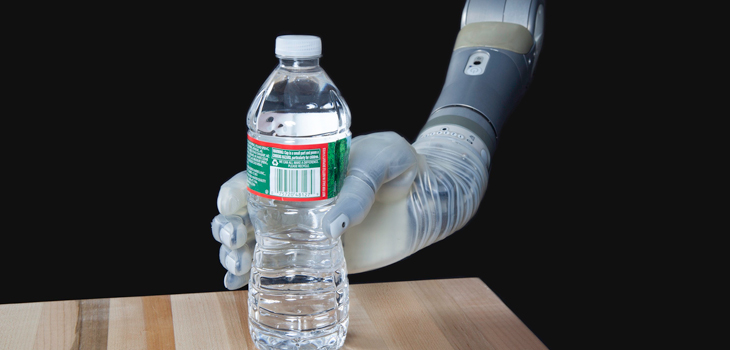
Mobius Bionics LLC has recently announced that the first two LUKE (Life Under Kinetic Evolution) prosthetic arms have been provided to the United States Department of Veterans Affairs for prescription to veterans.
Two LUKE Prosthetic Arms Now Available to Veterans
2 min read Premium comments
Secondary
According to a press release the LUKE arm “provides advanced features and capabilities including state-of-the art flexibility, strength, and dexterity,” allowing people with forearm through shoulder-level amputations to enjoy greater independence.
The LUKE arm was developed by DEKA Research & Development Corp. with funding from the Defense Advanced Research Projects Agency (DARPA) to meet the needs of wounded warfighters. It is the first arm cleared by the FDA as a fully integrated prosthetic arm for amputees across a range of levels of amputation, including shoulder-level, above-elbow, and below-elbow.
The shoulder-level configuration allows amputees to be able to reach above their heads and behind their backs. Simple things like picking up a bag of groceries or pouring a glass of milk for themselves will be possible again.
One of the first recipients of the LUKE arm was Fred Downs, a prosthetics consultant for the Paralyzed Veterans of American and retired Chief Procurement and Logistics Officer for the Veterans Health Administration, who lost his left arm above the elbow during the Vietnam War.
His LUKE arm is mounted on a custom-fit, interface socket created by Matt Albuquerque, president of Next Step Bionics and Prosthetics of Manchester, New Hampshire.
“This technology is the most significant advancement in upper-limb prosthetics in decades. It’s a wonderful feeling to see it being deployed to veterans, and I’m honored to be one of the early recipients,” Downs said in the release.
“The VA has been a critically important partner to DARPA and DEKA in the testing and refinement of the most advanced prosthetic technology available, and we are excited that the [Department of Veteran’s Affairs] is now helping Mobius Bionics to bring the LUKE arm to its first prescription users.
“Because of the unwavering supports of DARPA, the LUKE arm is now available to everyone who needs it, especially those who lost an arm in military services to our country, Dean Kamen, president of DEKA, said in the release.
Jarrett Porter, a technical support engineer at Mobius Bionics told OTW that the LUKE arm is provided to a certified prosthetist, who does the fitting process, creating a socket that the user can put on themselves with the arm attached.
He said, “The prosthetist also sets up the patient with the correct inputs to control the arm and configures the arm to their unique control scheme using special software provided by Mobius Bionics. This is a very important process, and is the primary determinant of how comfortable and functional the arm will be for the user.”
Porter added, “The initial fitting process always includes both training in the operation of the arms and controls, as well as some amount of occupational therapy to ensure that clients are able to accomplish the most activities of daily living that they can.”
Mobius Bionics offers training and support to prosthetists and therapists who manage the fitting and training of end users.
Author
React:
Discussion
This is a fascinating development. In my practice we've seen similar outcomes with the revised protocol. The key differentiator seems to be patient selection criteria. Has anyone else noticed the correlation with BMI thresholds?
Great point. I'd push back slightly on the conclusion, the sample size in the cited study is too small to draw population-level inferences. That said, the directional signal is compelling and worth a larger RCT.
We implemented a similar approach last year. Early results are promising but we're still gathering 12-month follow-up data. Happy to share our protocol if anyone is interested.
Join the conversation
Orthopedic professionals are discussing this. Sign in and upgrade to read every comment and add your voice.