
Atlanta-based Vertera Spine has announced that the U.S. Centers for Medicare & Medicaid Services (CMS) has issued a new ICD-10 code for a radiolucent porous interbody fusion device, leaving Vertera’s COHERE Cervical Interbody Fusion Device as the only product approved for use with the new code.
Specific ICD-10 Code Issued for Vertera’s COHERE Cervical Implant
2 min read Premium comments
Secondary
“The issuance of this new code signifies the unique performance of porous PEEK devices compared with other fusion devices and the importance of monitoring how this technology impacts healthcare,” said Richard Guyer, M.D., Texas Back Institute, in the June 14, 2017 news release. “As a clinician, I am always looking for innovative technologies, such as Vertera Spine’s porous PEEK [polyether ether ketone] COHERE device, that have the potential to improve patient outcomes.”
Kevin Foley, M.D., Semmes-Murphey Neurologic and Spine Institute, Memphis, Tennessee, added, “The development of porous PEEK has allowed for the combination of radiolucency and porosity in an interbody implant that is completely plastic. In vivo studies have demonstrated that bone will grow into porous implants, improving their osseointegration. Until now, the only porous implants clinically available were made of metal or had a metallic coating, which can limit the surgeon’s ability to assess fusion on imaging. This new code gives us the potential to better correlate bony tissue ingrowth into Vertera Spine’s porous PEEK COHERE device with clinical outcomes.”
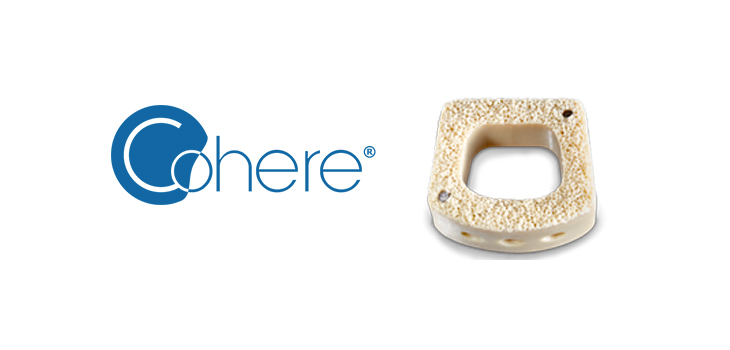
“With its first clinical use in Q2 of 2016, COHERE is the first device featuring Vertera Spine’s patented porous PEEK biomaterial technology,” says the news release. “Intended for use in anterior cervical fusion surgery, COHERE contains a three-dimensional porous architecture on its bone-contacting sides that is specifically designed and optimized to promote cellular bone formation and effectively form a strong interface with bone. Unlike some porous treatments that are coated onto the device, COHERE’s porous architecture is grown directly from the solid PEEK implant using a proprietary processing method that allows for bone tissue ingrowth on the surface, while retaining strength and durability.”
Chris Lee. Ph.D., founder and CEO of Vertera Spine, told OTW, “The most exciting aspect of the new code is that healthcare facilities now have a means to track utilization and costs associated with using a radiolucent porous device. A radiolucent porous device is unprecedented in spine surgery until now with the COHERE porous PEEK device. CMS’ issuance of the code signifies their recognition of the innovation and potential clinical benefits of porous PEEK and therefore, the need to track its clinical use.”
“By being able to track clinical outcomes with the new code, surgeons can monitor how porous PEEK can improve their patient outcomes. Because porous PEEK allows for bone ingrowth inside its porous architecture and is radiolucent, surgeons also now have the potential capability to correlate bone tissue ingrowth with their patients’ clinical outcomes.”
Author
React:
Discussion
This is a fascinating development. In my practice we've seen similar outcomes with the revised protocol. The key differentiator seems to be patient selection criteria. Has anyone else noticed the correlation with BMI thresholds?
Great point. I'd push back slightly on the conclusion, the sample size in the cited study is too small to draw population-level inferences. That said, the directional signal is compelling and worth a larger RCT.
We implemented a similar approach last year. Early results are promising but we're still gathering 12-month follow-up data. Happy to share our protocol if anyone is interested.
Join the conversation
Orthopedic professionals are discussing this. Sign in and upgrade to read every comment and add your voice.