
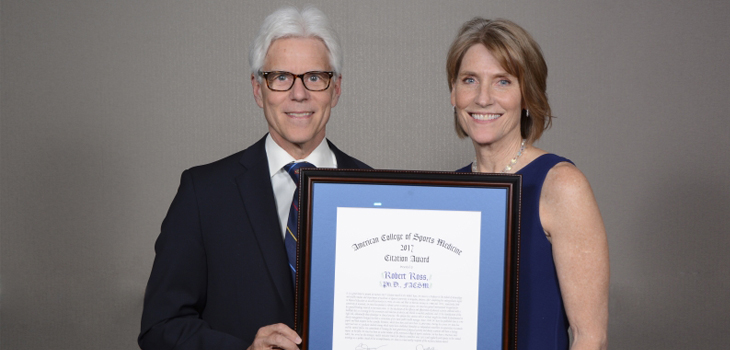
Robert Ross, Ph.D., FACSM, recently received the 2017 American College of Sports Medicine Citation Award for his research in sports medicine and the exercise sciences at the association’s annual meeting in Denver, Colorado.
Robert Ross Receives 2017 ACSM Citation Award
1 min read Premium comments
Secondary
Ross, a professor in the School of Kinesiology and Health Studies and Department of Medicine at Queen’s University in Kingston, Ontario, Canada, has published almost 190 papers and book chapters and has been cited over 15,000 times.
Recently, he led a new American Heart Association scientific statement published in Circulation in late 2016 that confirmed that cardiorespiratory fitness (CRF) should always be measured in clinical practice to improve patient management and to encourage the adoption of lifestyle-based strategies proven to reduce cardiovascular risk.
He has also supervised over many graduate students who have gone on to also have vibrant careers in independent research at universities both in Canada and the United States.
“Citation Award winners are selected for their leadership and contributions in the areas of research and scholarship, clinical care, administrative services or educational services,” said Walter Thompson, FACSM, president of the American College of Sports Medicine (ACSM) in a press release. “We’re happy to recognize Dr. Ross’ tremendous accomplishments.”
Ross became an ACSM fellow in 2009 and has been a member of the Strategic Health Initiative (SHI) for Obesity Committee since 2013, and is a frequent speaker at ACSM annual meetings. He received his master’s in 1988 and doctorate in exercise science in 1992 from the University of Montreal.
Author
React:
Discussion
This is a fascinating development. In my practice we've seen similar outcomes with the revised protocol. The key differentiator seems to be patient selection criteria. Has anyone else noticed the correlation with BMI thresholds?
Great point. I'd push back slightly on the conclusion, the sample size in the cited study is too small to draw population-level inferences. That said, the directional signal is compelling and worth a larger RCT.
We implemented a similar approach last year. Early results are promising but we're still gathering 12-month follow-up data. Happy to share our protocol if anyone is interested.
Join the conversation
Orthopedic professionals are discussing this. Sign in and upgrade to read every comment and add your voice.