
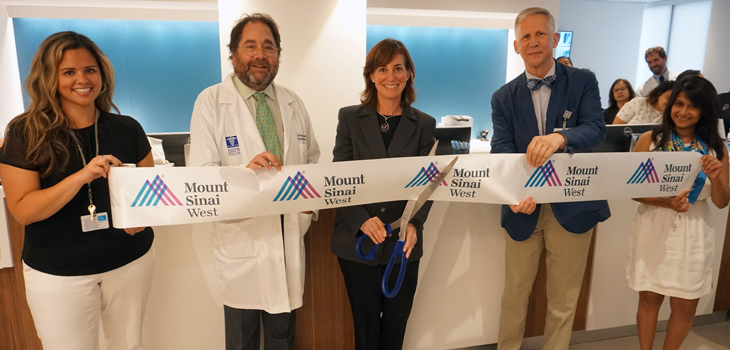
Growing orthopedic competition in New York City these days…Mount Sinai has just opened the Orthopaedic Center at Mount Sinai West.
Mount Sinai Opens Major Ortho Center on “West Side”
2 min read Premium comments
Secondary
According to Mount Sinai, this new facility, located at 425 West 59th Street, is the first of its kind on Manhattan’s West Side, with state-of-the-art equipment and exam rooms to enhance patient experience and care. All patients on the West Side will be served by the Orthopaedic Center at Mount Sinai, a facility offering a larger space to accommodate more patients and physicians specializing in all areas of orthopedics.
Michael Bronson, M.D., Chair, Department of Orthopaedics, Mount Sinai West; Chief, Joint Replacement Surgery, Mount Sinai West; and Associate Professor, Icahn School of Medicine at Mount Sinai, will direct the Orthopaedic Center at Mount Sinai West.
“We are extremely excited about the opening of our new facility, which will provide patients throughout the city and especially on the west side of Manhattan with state-of-the-art care, and give them access to orthopedic physicians in all sub-specialties,” said Dr. Bronson in the July 14, 2017 Mount Sinai news release. “The Center will also provide immediate access to patients with acute orthopedic problems so these can be addressed in a timely manner. A larger facility means patients won’t have to wait weeks or months to see a world-renowned specialist.”
The company wrote in the news release, “Four new surgeons have joined the center’s 12 existing physicians to expand care and services in the areas of total joint replacement, sports medicine, spine, foot and ankle, shoulder, elbow and hand injuries. This facility gives patients new and direct on-site access to radiologists, rheumatologists, and pain management physicians for coordinated care.”
“Additionally, the Orthopaedic Center at Mount Sinai West will serve as a major teaching site for medical students, residents, and fellows in all areas of orthopedics. This will add an extra level of expertise on the West Side, leading to increased medical research and breakthroughs in treatments to advance patient care.”
“The Orthopaedic Center at Mount Sinai West represents Mount Sinai’s commitment to growth of the Department of Orthopaedics and signifies integration of care and dedication to patients on the West Side,” said Leesa Galatz, M.D., System Chair, Orthopaedics, Mount Sinai Health System, and Mount Sinai Professor, Leni and Peter W. May Department of Orthopaedic Surgery, Icahn School of Medicine at Mount Sinai. “This is a center for excellence in orthopedics and patients will know that when they come here they will get exemplary care.”
Dr. Bronson told OTW, “We are extremely pleased with our center. Significant plans include transforming our center into a musculoskeletal institute where not only do we have sub specialists in every aspect of orthopedics, but we will include rheumatology and pain management. Within the next year, we will expand our spine center and add additional sub specialists in hand and upper extremity.”
Author
React:
Discussion
This is a fascinating development. In my practice we've seen similar outcomes with the revised protocol. The key differentiator seems to be patient selection criteria. Has anyone else noticed the correlation with BMI thresholds?
Great point. I'd push back slightly on the conclusion, the sample size in the cited study is too small to draw population-level inferences. That said, the directional signal is compelling and worth a larger RCT.
We implemented a similar approach last year. Early results are promising but we're still gathering 12-month follow-up data. Happy to share our protocol if anyone is interested.
Join the conversation
Orthopedic professionals are discussing this. Sign in and upgrade to read every comment and add your voice.