
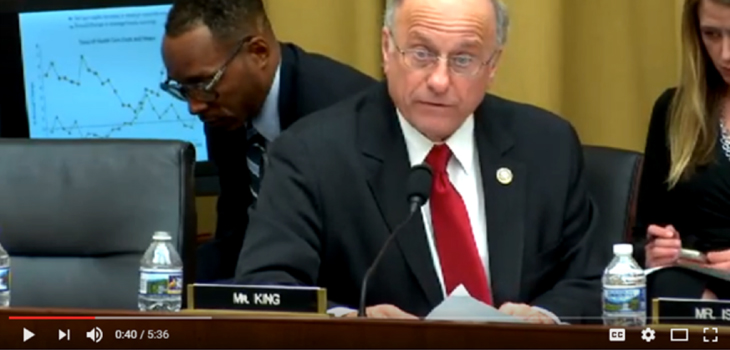
The Protecting Access to Care Act (PACA) of 2017, sponsored by Iowa Republican Congressman Steve King, is winding its way through the Congress and is odds on favorite to become the law of the land.
Medical Liability Laws Changing
3 min read Premium comments
Secondary
Known colloquially as the common sense liability form, PACA was inspired by the Medical Injury Compensation Reform Act (MICRA) in California, which was a statute enacted by the California Legislature in September 1975 (and signed into law by Governor Jerry Brown).
Its purpose was to lower medical malpractice liability insurance premiums for healthcare providers in that state by decreasing their potential tort liability.
And by most accounts (excluding the plaintiff’s bar), it succeeded.
Unpacking PACA
The nonpartisan Congressional Budget Office (CBO) estimates that PACA will lower premiums for medical malpractice insurance and reduce the incentives for physicians to practice defensive medicine with all its unnecessary services.
According to the CBO analysis, PACA would decrease national health spending by 0.4% and save the federal government almost $50 billion over the next 10 years. The estimate was based on the experience in the many states that have already enacted similar measures. Many PACA supporters point to the experience in states like Texas where the PACA-style law is credited with reversing the exodus of physicians who were concerned with frivolous lawsuits.
PACA-style caps on noneconomic damages in malpractice cases are on the books in 26 states, according to the publication Medical Liability Monitor.
At the heart of the bill is a cap for appropriate compensation for patients, inclusive of all damages. PACA ensures that both past and future expenses are included in awards for patients, which encompasses lost earning potential and past wages, cost of rehabilitations, and other expenses. There’s also a $250,000 option for non-economic losses like pain and suffering.
Here are five key takeaways from the House PACA bill:
- Impose sliding-scale limits on the contingency fees of plaintiffs’ attorneys. They could receive only 40% of the first $50,000 awarded to an injured patient, 33% of the next $50,000, 25% of the next $500,000, and 15% of damages topping $600,000.
- Exempt clinicians who order a drug or medical device from class-action or product-liability lawsuits.
- Pay damages in installments instead of all at once when they exceed $50,000.
- Replace joint-and-several liability with a Fair Share rule. Under joint-and-several liability, a plaintiff can recover all court-awarded damages from one of several defendants, even if he or she is only partly responsible for the injury. The Fair Share rule divvies up damages among multiple defendants based on their percentage of responsibility.
- Encourage speedy resolution of claims. The statute of limitations for a malpractice suit would be three years after the date of the wrongful act, or one year after the plaintiff discovers it, whichever comes first.
Doing the Math
“Defensive medicine” is a byproduct of a lawsuit-addicted culture. Some medical professionals may order costly tests, CT scans or other treatments in order to protect themselves from potential lawsuits—even when there is little or no evidence to back up such orders.
PACA supporters estimate that defensive medicine costs up to $289 billion each year.
Since 68% of medical liability claims are dismissed, withdrawn or dropped and 88% of those that do end up in trial are awarded to the providers, it’s a costly game for practitioners. It’s very expensive for a physician to act as a defendant in such claims, and PACA means medical liability insurance premiums would be drastically reduced. In some cases, surgeons have even chosen not to undertake surgeries solely due to litigation fears—which had led to a lack of qualified professionals for patients in need.
PACA also offers protection and customization options for states that already boast similar, effective programs.
Author
React:
Discussion
This is a fascinating development. In my practice we've seen similar outcomes with the revised protocol. The key differentiator seems to be patient selection criteria. Has anyone else noticed the correlation with BMI thresholds?
Great point. I'd push back slightly on the conclusion, the sample size in the cited study is too small to draw population-level inferences. That said, the directional signal is compelling and worth a larger RCT.
We implemented a similar approach last year. Early results are promising but we're still gathering 12-month follow-up data. Happy to share our protocol if anyone is interested.
Join the conversation
Orthopedic professionals are discussing this. Sign in and upgrade to read every comment and add your voice.