
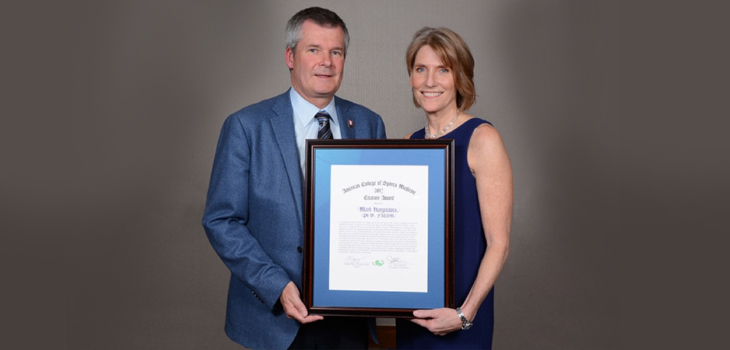
Mark Hargreaves, Ph.D., FACSM, a professor of physiology at the University of Melbourne in Australia received the 2017 American College of Sports Medicine Citation Award at the association’s recent annual meeting in Denver, Colorado.
Mark Hargreaves Receives 2017 ACSM Citation Award
1 min read Premium comments
Secondary
Hargreaves was awarded for his contributions to sports medicine and exercise sciences research. His main research focus has been on better understanding the cellular mechanisms that regulate muscle metabolism during exercise and what effect training and nutritional manipulations may have on those mechanisms. His research has been funded by the Australian Sports Commission, the National Health and Medical Research Council of Australia, the Australian Research Council and the Diabetes Australia Research Trust.
“Citation Award winners are selected for their leadership and contributions in the areas of research and scholarship, clinical care, administrative services or educational services,” said Walter Thompson, FASCM, president of the American College of Sports Medicine (ACSM) in a press release. “We are happy to recognize Dr. Hargreaves tremendous accomplishments.”
Hargreaves’ work has been published in more than 120 peer-reviewed journals and 65 book chapters and invited reviews, and has been cited more than 5,600 times. He has also received the American College of Sports Medicine’s Young Investigator Award and the Australian Physiological Society’s McIntyre Prize, both in 1994.
One of the most recent studies he participated in, which was published in the June issue of the Journal of Science & Medicine in Sport, evaluated the physical activity training in Australian medical school. The researchers found that while most schools included some physical activity training, they did not always include national strength recommendations.
Hargreaves has served on the ACSM’s board of trustees as a foreign corresponding editor of Medicine & Science in Sports & Exercise, associate editor of Exercise and Sport Sciences Reviews and consulting editor of the Journal of Applied Physiology. He received his masters’ degree in exercise physiology from Ball State University in 1984 and his Ph.D. in physiology from the University of Melbourne in 1989.
Author
React:
Discussion
This is a fascinating development. In my practice we've seen similar outcomes with the revised protocol. The key differentiator seems to be patient selection criteria. Has anyone else noticed the correlation with BMI thresholds?
Great point. I'd push back slightly on the conclusion, the sample size in the cited study is too small to draw population-level inferences. That said, the directional signal is compelling and worth a larger RCT.
We implemented a similar approach last year. Early results are promising but we're still gathering 12-month follow-up data. Happy to share our protocol if anyone is interested.
Join the conversation
Orthopedic professionals are discussing this. Sign in and upgrade to read every comment and add your voice.