
AMNIOX Medical, Inc., a TissueTech, Inc. company, announced results from a clinical study of Cryopreserved Amniotic Membrane in lumbar microdiscectomy surgery.
AMNIOX: Positive Results for CLARIX in Lumbar Microdiscectomy
2 min read Premium comments
Secondary
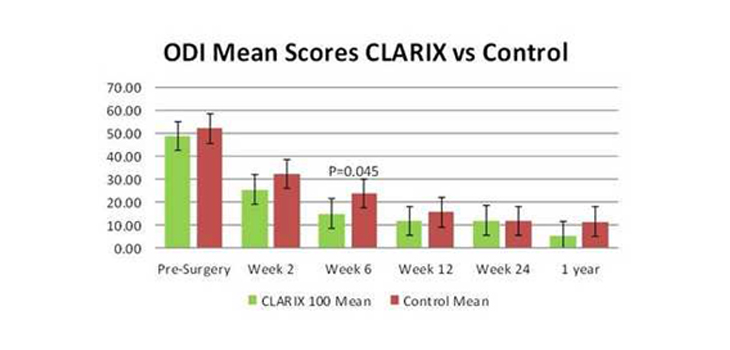
The study, led by D. Greg Anderson, M.D., of Rothman Institute in Philadelphia, found that pain decreased and function increased after the use of AMNIOX Medical’s CLARIX brand of amniotic membrane. Their work, “Cryopreserved Amniotic Membrane Improves Clinical Outcomes Following Microdiscectomy,” was published in the May 2017 online issue of Clinical Spine Surgery.
Of the 80 prospectively randomized patients, 40 received the CLARIX 100, a CryoTek cryopreserved placental tissue, placed in the annular defect upon removal of the disc fragment during microdiscectomy, and another 40 underwent the exact same surgery without adjunctive tissue placement.
According to the July 10, 2017 news release, “None of the patients who received CLARIX 100 experienced re-herniation during the two-year follow-up period, while 7.5 percent of the control group demonstrated re-herniation. Specifically, three control group patients experienced a re-herniation at the same level, with two of the three requiring spinal fusion to manage persistent pain.”
“A third cohort of 40 patients—not included in the results published in Clinical Spine Surgery—is currently being enrolled. Those patients are receiving CLARIX CORD 1K, the first cryopreserved umbilical cord tissue available to the market. This umbilical cord product is more potent than the amniotic membrane product. Dr. Anderson presented the interim findings of the umbilical cord cohort at the International Society for the Advancement of Spine Surgery 2017 conference in April; and those early results indicate that patients are responding even more favorably to treatment with the proprietary umbilical cord technology.”
“Amniox Medical’s parent company, TissueTech, pioneered the commercialization and clinical application of human umbilical cord and amniotic membrane to promote regenerative healing. This restorative ability is innate to these placental tissues and can be preserved and transplanted to adults. Heavy chain hyaluronic acid/pentraxin-3 (HC-HA/PTX3) is the key protein complex present in these tissues to orchestrate that regenerative healing process. Amniox Medical utilizes its proprietary CryoTek process, a cryopreservation technology, to preserve the biological and structural integrity of these tissues more effectively than other available technologies. Since the company’s inception, clinicians have performed more than 300,000 human transplants of its products and published more than 300 peer-reviewed studies supporting its technology platform.”
Dr. Anderson told OTW, “Recurrent herniations and low back pain remain unsolved problems for patients following lumbar microdiscectomy. The study was designed to test the hypothesis that amniotic tissue, implanted to the annular defect would be able to improve the outcomes following microdiscectomy.”
“We found that patients who received amniotic tissue at the annular defect during microdiscectomy surgery had less pain and better functional outcomes out to the two year time point. In addition, there were less recurrent herniations in the group receiving the amniotic tissue grafts.”
Author
React:
Discussion
This is a fascinating development. In my practice we've seen similar outcomes with the revised protocol. The key differentiator seems to be patient selection criteria. Has anyone else noticed the correlation with BMI thresholds?
Great point. I'd push back slightly on the conclusion, the sample size in the cited study is too small to draw population-level inferences. That said, the directional signal is compelling and worth a larger RCT.
We implemented a similar approach last year. Early results are promising but we're still gathering 12-month follow-up data. Happy to share our protocol if anyone is interested.
Join the conversation
Orthopedic professionals are discussing this. Sign in and upgrade to read every comment and add your voice.