
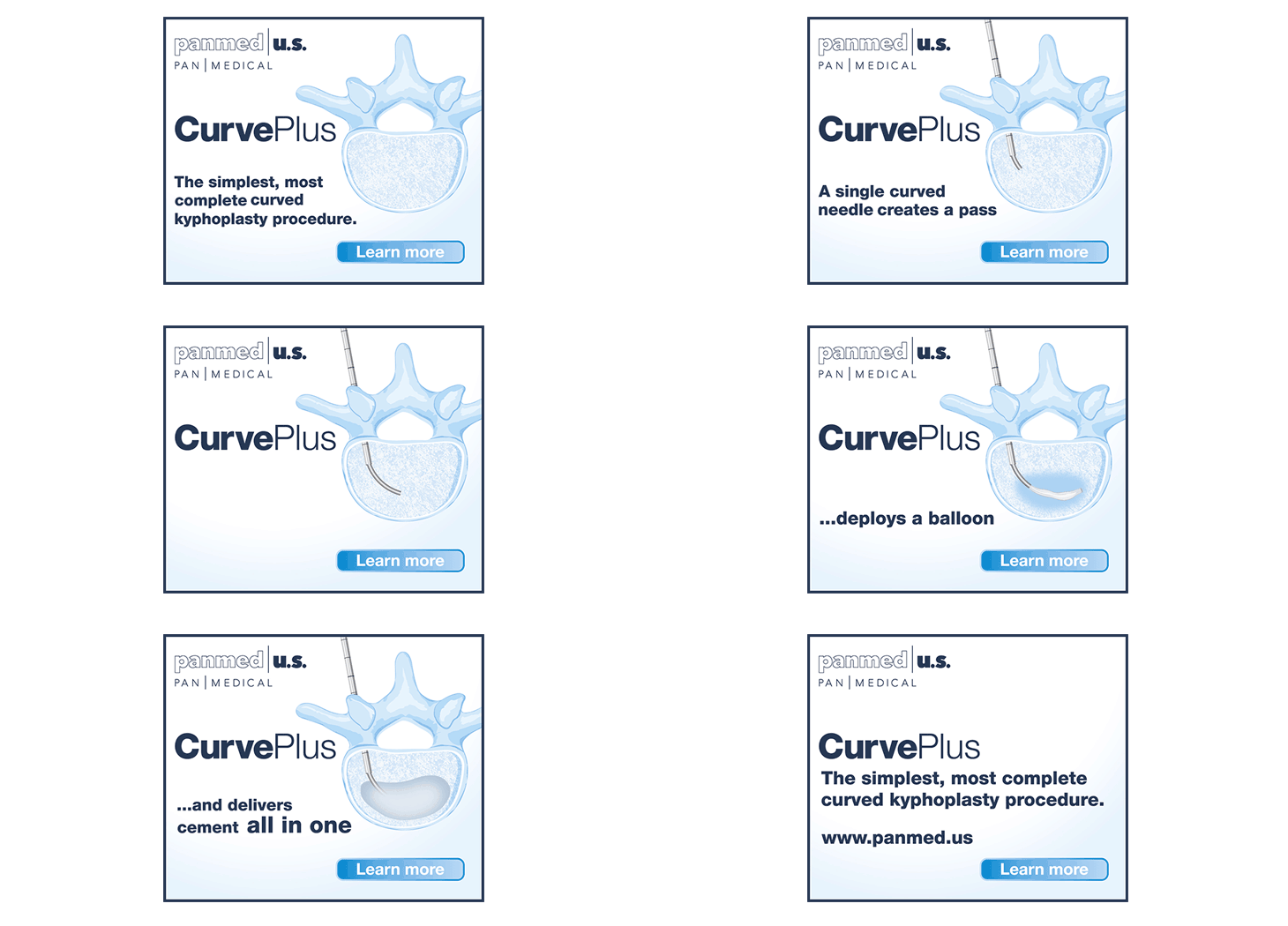
PanMed U.S., based in Tampa, Florida, is announcing the launch of the CurvePlus, a curved kyphoplasty device. Commenting on their patent pending device in a June 8, 2017 news release, the company indicated, “…this new product allows for the simplest, quickest, most complete curved kyphoplasty procedure.”
PanMed U.S. Launches CurvePlus—Curved Kyphoplasty Device
1 min read Premium comments
Secondary
“A unipedicular approach is created and a curved needle is inserted into its ideal location. A new 510K cleared 13G balloon creates a passage through the 10G curved needle to reach the optimal position. The balloon is inflated, deflated and removed. The curved needle stays in place for cement delivery.”
Jennie Budding, vice president of research and development, commented, “The CurvePlus has shown in pre-clinical trials to be the quickest, simplest, most complete procedure and has been successfully proven in different spine and pain management centers.”
Asked about the development process, Max Nasralla, president and chief executive officer of PanMed U.S. commented to OTW, “During the development process of the CurvePlus one of the difficulties we encountered was to be able to produce a very low profile 13G balloon kyphoplasty catheter with high torque and flexibility to enter easily the inner lumen of a 10G curved nitinol needle to make the procedure achievable.
“Surgeons who experienced on a trial basis the CurvePlus are either identifying this product as a revolutionary approach to the kyphoplasty curve platform. The procedure is quick, it takes less than five minutes, it is extremely simple and it is fully complete as all is done in one single step.”
“Orthopaedic surgeons should be more and more aware that the old fashioned lengthy bi-lateral Kyphon Kyphoplasty procedure is a thing of the past, a simpler, quicker, minimally invasive, with low profile is available on the kyphoplasty curved platform.”
Author
React:
Discussion
This is a fascinating development. In my practice we've seen similar outcomes with the revised protocol. The key differentiator seems to be patient selection criteria. Has anyone else noticed the correlation with BMI thresholds?
Great point. I'd push back slightly on the conclusion, the sample size in the cited study is too small to draw population-level inferences. That said, the directional signal is compelling and worth a larger RCT.
We implemented a similar approach last year. Early results are promising but we're still gathering 12-month follow-up data. Happy to share our protocol if anyone is interested.
Join the conversation
Orthopedic professionals are discussing this. Sign in and upgrade to read every comment and add your voice.