
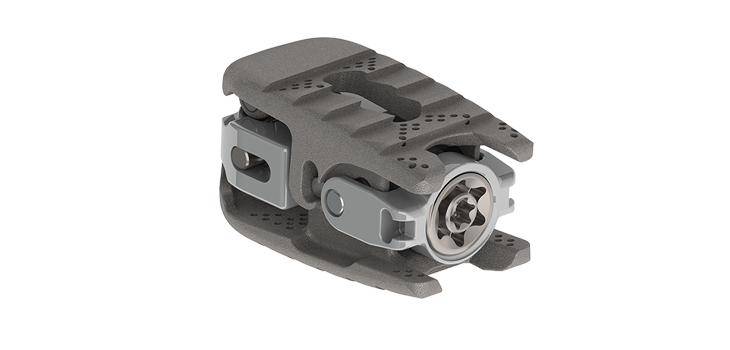
K2M Group Holdings, Inc. stakes claim to be the first leading spine company to market a 3D-printed titanium interbody device. Now the company is adding to its portfolio after receiving 510(k) clearance for its MOJAVE PL 3D Expandable Interbody System.
First 3D Expandable Interbody System Cleared by FDA
2 min read Premium comments
Secondary
That clearance, according to a June 22, 2017 company announcement, allows the company to be the first-to-market with an FDA-cleared, 3D-printed expandable posterior-lumbar (PL) interbody system. The company also said it offers the most comprehensive portfolio of 3D-printed spinal devices.
The fusion device features K2M’s Lamellar 3D Titanium Technology and is designed to allow for independent control of the anterior and posterior height in the lumbar spine. The company says this is a new capability not available with any other product in the market today. Featuring infinite adjustment within the expansion range, the implant may be locked at any desired height and lordosis to aid in the restoration of sagittal balance.
Steven Ludwig, M.D., an orthopedic spine surgeon and professor of orthopedics at the University of Maryland Medical Center in Baltimore says the ability to provide independent control of both the anterior and posterior height separately “is desirable for the restoration of sagittal balance compared to existing devices that can’t independently adjust both anterior and posterior height.”
K2M’s Lamellar 3D Titanium Technology uses an advanced 3D printing method to create structures that, according to the company, “are impossible with traditional manufacturing techniques. Starting with a titanium powder, the MOJAVE PL 3D endplates are grown through the selective application of a high-energy laser beam, incorporating complex internal geometries and rough surface architecture that pre-clinical data have associated with bone growth activity. Lamellar 3D Titanium Technology incorporates a porous structure along with rough surfaces to allow the potential for bony integration throughout the endplates.”
K2M President and CEO Eric Major said as the first-ever, FDA-cleared, 3D-printed expandable interbody technology, the system, “exemplifies our leadership in this space and provides surgeons the ability to expand the implant in-situ. This is our second family of products featuring Lamellar 3D Titanium Technology and builds upon the incredibly successful CASCADIA 3D family of static 3D-printed interbody cages. Our continued innovation in 3D solutions and our focus on 3D spinal balance, demonstrated by the recent launch of our Balance ACS platform, solidifies our position as a market leader and innovator in the industry.”
Author
React:
Discussion
This is a fascinating development. In my practice we've seen similar outcomes with the revised protocol. The key differentiator seems to be patient selection criteria. Has anyone else noticed the correlation with BMI thresholds?
Great point. I'd push back slightly on the conclusion, the sample size in the cited study is too small to draw population-level inferences. That said, the directional signal is compelling and worth a larger RCT.
We implemented a similar approach last year. Early results are promising but we're still gathering 12-month follow-up data. Happy to share our protocol if anyone is interested.
Join the conversation
Orthopedic professionals are discussing this. Sign in and upgrade to read every comment and add your voice.