
Due to requirements of the 21st Century Cures Act, it just got easier for medical device makers to get approval from the FDA for devices falling under the Humanitarian Device Exemptions (HDEs) category.
FDA Eases Humanitarian Device Exemptions Requirements
2 min read Premium comments
Secondary
In a June 7, 2017 filing in the Federal Register, the agency announced amendments that change the threshold of number of individuals affected by a medical condition and changed requirements for Institutional Review Board (IRB) oversight for humanitarian use devices.
First, the agency doubled the number of individuals affected by a medical condition from 4,000 to 8,000 individuals to get FDA approval. Second, the agency amended the requirements for IRB oversight for humanitarian use devices to remove the term, “local.”
RAPS (Regulatory Affairs Professionals Society) reported that the IRB change reflects a shift in in the clinical landscape toward using a single or central IRB for multi-site studies.
In part, the 21st Century Cures Act modified the FDA approval process. The act was intended to speed up the process by which devices are approved by the FDA. Under certain conditions, the act allows companies to provide “data summaries” and “real world evidence” such as observational studies, insurance claims data, patient input, and anecdotal data rather than full clinical trial results.
Humanitarian Use Device
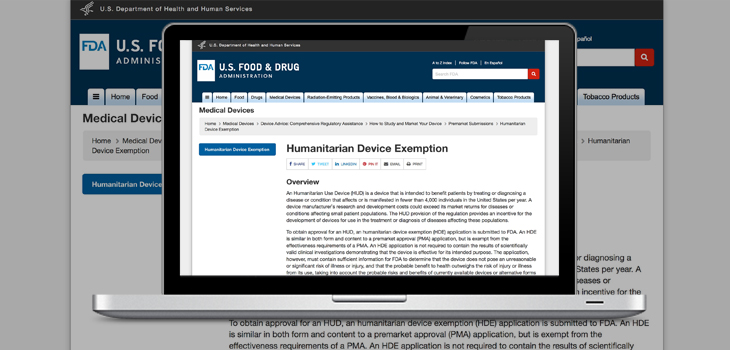
According to the FDA, a Humanitarian Use Device (HUD) is a device that is intended to benefit patients by treating or diagnosing a disease or condition that affects, now, no more than 8,000 individuals in U.S. per year. A device manufacturer’s research and development costs could exceed its market returns for diseases or conditions affecting small patient populations. The HUD provision of the regulation provides an incentive for the development of devices for use in the treatment or diagnosis of diseases affecting these populations.
To obtain approval for an HUD, an HDE application is submitted to FDA.
An HDE is similar to a premarket approval (PMA) application, but is exempt from the effectiveness requirements of a PMA.
An HDE application is not required to contain the results of scientifically valid clinical investigations demonstrating that the device is effective for its intended purpose. The application, however, says the FDA, “must contain sufficient information for FDA to determine that the device does not pose an unreasonable or significant risk of illness or injury, and that the probable benefit to health outweighs the risk of injury or illness from its use, taking into account the probable risks and benefits of currently available devices or alternative forms of treatment.”
Additionally, the applicant must demonstrate that no comparable devices are available to treat or diagnose the disease or condition, and that they could not otherwise bring the device to market.
FDA issued these amendments as a final rule without notice and comment because the amendments only updated the implementing regulations to restate the statute in light of amendments recently enacted into law.
To read the entire Federal Registry notice, click here.
Author
React:
Discussion
This is a fascinating development. In my practice we've seen similar outcomes with the revised protocol. The key differentiator seems to be patient selection criteria. Has anyone else noticed the correlation with BMI thresholds?
Great point. I'd push back slightly on the conclusion, the sample size in the cited study is too small to draw population-level inferences. That said, the directional signal is compelling and worth a larger RCT.
We implemented a similar approach last year. Early results are promising but we're still gathering 12-month follow-up data. Happy to share our protocol if anyone is interested.
Join the conversation
Orthopedic professionals are discussing this. Sign in and upgrade to read every comment and add your voice.