
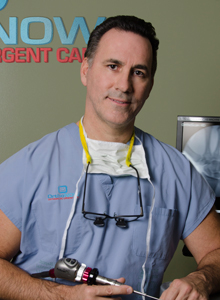
You might call him the oracle of orthopedics…Alejandro Badia, M.D., co-founder and chief medical officer of OrthoNOW, surveyed the healthcare landscape, saw the signs, and set off in a new direction led by a determination to enhance patient care.
Alejandro Badia, M.D. Named Finalist in Health Care Heroes Awards
2 min read Premium comments
#orthopedics#alejandrobadia#orthonow
Now, Dr. Badia’s innovative approach has led to his being named a finalist of the Greater Miami Chamber of Commerce’s annual Health Care Heroes Awards. According to the May 10, 2017 company announcement, this award recognizes the collective actions of the individuals, institutions, and programs that have made an extraordinary impact in the South Florida healthcare community and whose acts of heroism represent a display of dedication to excellence in their area of expertise beyond the scope of their profession.
Dr. Badia, a hand and upper limb surgeon in Miami, Florida, created OrthoNOW, the nation’s only orthopedic urgent care franchise, because he saw ways to trim the fat out of healthcare delivery. He told OTW, “Everywhere I looked I found valuable resources being squandered: patient time, physician time, and money leaking out of the system. I collaborated with Justin Irizarry, a Wharton graduate, and we developed a model of care delivery that would provide aching patients with state-of-the-art care…and do so in an expedited fashion.”
“What makes our business model unique is the emphasis we place on the delivery of specialized, value based care accessible on demand. We circumvent the waste associated with the traditional health care delivery method. People with orthopedic issues are typically directed to an emergency room and after an initial consult and a battery, often, of unnecessary and costly tests, are directed to see a specialist. And many times, patients initially go to a general urgent care center, which typically adds an unnecessary and expensive step as the patient still needs to see an orthopedic specialist to make an accurate determination. Our ‘direct to the specialist’ process saves the patient time and money and results in a superior clinical experience for both the patient and the provider.”
“Dr. Alejandro Badia has a burning desire to democratize access to the best in class healthcare, building a new business model that fundamentally changes how people and patients access orthopedic care,” said Justin Irizarry, co-founder and chief financial officer of OrthoNOW, in the news release.
As for OrthoNOW’s future expansion, Dr. Badia commented to OTW, “Our plans always include providing the best possible orthopedic care for our patients. Specific to the next 6-12 months, however, our focus includes continued expansion of the franchise across the country. This effort is being led by our Chief Development Officer, Christine Dura, a 20 year veteran of global expansion of emerging franchise brands. As a testament to our growth, we opened six locations in Florida and Georgia in 2016 and within the next 6-12 months we will have over 50 OrthoNOW locations in development from coast to coast.”
Author
React:
Discussion
This is a fascinating development. In my practice we've seen similar outcomes with the revised protocol. The key differentiator seems to be patient selection criteria. Has anyone else noticed the correlation with BMI thresholds?
Great point. I'd push back slightly on the conclusion, the sample size in the cited study is too small to draw population-level inferences. That said, the directional signal is compelling and worth a larger RCT.
We implemented a similar approach last year. Early results are promising but we're still gathering 12-month follow-up data. Happy to share our protocol if anyone is interested.
Join the conversation
Orthopedic professionals are discussing this. Sign in and upgrade to read every comment and add your voice.