
They might be popping champagne at Titan Spine’s offices in Wisconsin and Germany these days.
Titan Spine: Record Sales and 1,000 Endoskeleton Implantations
2 min read Premium comments
Secondary
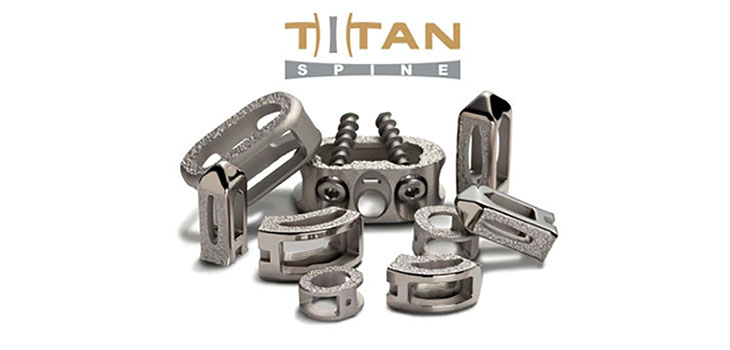
The company has achieved record sales revenue for the first quarter of 2017—and the company just exceeded 1,000 implantations of its Endoskeleton titanium interbody fusion devices featuring nanoLOCK surface technology.
The company reports in its April 24, 2017 news release, “Record quarterly sales for Q1 2017 that are significantly greater than prior year; nanoLOCK has been utilized to date by 74 surgeons in 52 hospitals across 26 states; nanoLOCK sales volume has increased by 270% since December 2016.”
Titan Spine Chief Commercial Officer Ted Bird commented, “Achieving record sales growth in the first quarter this year speaks to the accelerating demand for our surface-enhanced titanium interbody devices and an increasing appreciation of the importance of our proprietary nano-architecture in its ability to drive rapid osteogenesis…”
“Titan Spine offers a full line of Endoskeleton devices that feature Titan Spine’s proprietary nanoLOCK surface technology, consisting of a unique combination of roughened topographies at the macro, micro, and nano levels (MMN),” says the Titan Spine news release. “This unique combination of surface topographies is designed to create an optimal host-bone response and actively participate in the fusion process by promoting the upregulation of osteogenic and angiogenic factors necessary for bone growth, encouraging natural production of bone morphogenetic proteins (BMPs), downregulating inflammatory factors, and creating the potential for a faster and more robust fusion.”
Steve Cichy, company executive vice president of sales, told OTW, “We are not providing specific numbers, but our growth over Q1 prior year was a record for our company and many multiples over current market growth rates, which means we are aggressively taking market share.”
“We are certainly pleased, but not surprised, by our record sales performance last quarter. It is a result of the steps we took in 2016 to set the stage for accelerated sales growth. Namely, we launched our next-generation nanoLOCK surface technology and tripled and reorganized our sales organization to better serve our customers. We knew both of these moves would cause short term disruption, but we are now enjoying the dividends of making them.”
“Reaching the 1,000 implant milestone for nanoLOCK in such a short amount of time is the culmination of a well-executed launch plan. It began with FDA clearance in November of 2014 that marked the first, and still only, nanotechnology clearance for spinal technologies.”
“We then spent the next 18 months carefully planning for its launch, which included the construction of a nanotechnology manufacturing and validation facility, building inventory, and the dramatic expansion of our sales organization.”
“During that time, we were also able to gain sole access to the CMS [Centers for Medicare & Medicaid Services] new technology code for nanotextured interbody devices, once again validating the uniqueness of our nanoLOCK surface technology. By the time of our first case in September of last year, we were well prepared to execute the rapid nanoLOCK adoption we see today.”
Author
React:
Discussion
This is a fascinating development. In my practice we've seen similar outcomes with the revised protocol. The key differentiator seems to be patient selection criteria. Has anyone else noticed the correlation with BMI thresholds?
Great point. I'd push back slightly on the conclusion, the sample size in the cited study is too small to draw population-level inferences. That said, the directional signal is compelling and worth a larger RCT.
We implemented a similar approach last year. Early results are promising but we're still gathering 12-month follow-up data. Happy to share our protocol if anyone is interested.
Join the conversation
Orthopedic professionals are discussing this. Sign in and upgrade to read every comment and add your voice.