
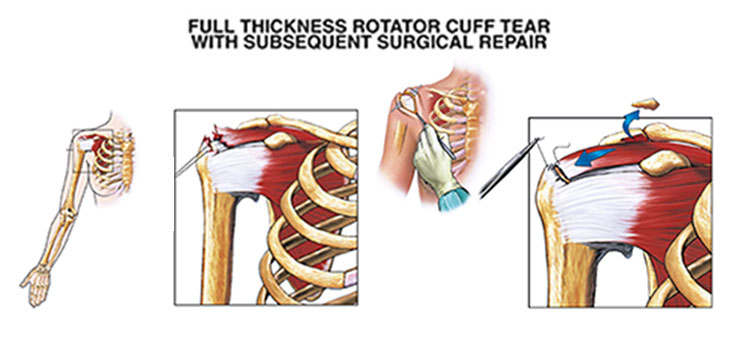
In the May 2017 issue of Arthroscopy, researchers found that linked single-row rotator cuff repair is as effective as standard simple suture single-row repair using triple-loaded suture anchors, indicating it might be a good alternative for patients with poor tissue quality.
Linked Single-Row Rotator Cuff Repair Shows Promise
1 min read Premium comments
Secondary
Mark H. Getelman, M.D., co-director of the Sports Medicine Fellowship at the Southern California Orthopedic Institute in Van Nuys, California and colleagues compared the time zero cyclic and failure loading properties of a linked single-row rotator cuff repair with a standard suture single-row repair using 18 human cadaveric shoulders from nine matched repairs.
According to the study results, there was no statistical difference in peak gap formation between the two techniques, and both averaged below a 5mm cyclic failure threshold. Overall, both techniques showed high ultimate load to failure and good resistance to gap formation with cyclic loading.
The researchers wrote, “The linked repair is a simplified rip-stop configuration using the existing suture that may perform similarly to current rotator cuff repair techniques.”
Getelman told OTW that his advice for surgeons choosing a rotator cuff repair technique would be: “IF the patient has thin or poor tissue available for repair the linked technique is easy to perform and biomechanically does not result in any compromise in strength.”
He said, “In general, the weakest link of a rotator cuff repair with the current anchors and sutures available is the suture tissue interface. It is often suggested that patients who have poor quality tissue will often benefit from more complex suture orientation techniques.”
“The linked technique appears to be biomechanically similar to simple sutures but surgeons often feel that complex sutures can provide better tissue holding capability and as such this technique appears to be superior to previously tested complex suture orientations.”
Author
React:
Discussion
This is a fascinating development. In my practice we've seen similar outcomes with the revised protocol. The key differentiator seems to be patient selection criteria. Has anyone else noticed the correlation with BMI thresholds?
Great point. I'd push back slightly on the conclusion, the sample size in the cited study is too small to draw population-level inferences. That said, the directional signal is compelling and worth a larger RCT.
We implemented a similar approach last year. Early results are promising but we're still gathering 12-month follow-up data. Happy to share our protocol if anyone is interested.
Join the conversation
Orthopedic professionals are discussing this. Sign in and upgrade to read every comment and add your voice.