
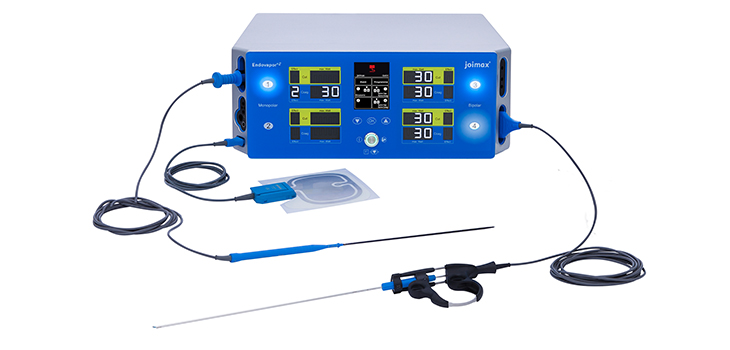
The FDA has granted German-based joimax GmbH 510(k) clearance for a patented device which generates electrical power for monopolar and bipolar cutting and coagulation of tissue structures in endoscopic surgical operations. The announcement was made at the Annual Scientific Meeting of the American Association of Neurological Surgeons (AANS) 2017, in Los Angeles, California.
joimax Endovapor Cleared by FDA
1 min read Premium comments
Secondary
The Endovapor 2 Multi Radio Frequency System, according to the April 26, 2017 press release, “is an all-in-one generator with specially integrated programs for spinal cord surgery with interdisciplinary application. The device is equipped with two monopolar and two bipolar sockets and an easy and intuitive touchpad technology. With arc control for safe application and easy neutral electrode monitoring, it combines a variety of different electro-surgical modes and effects.”
According to the company, “all device settings are pre-programmed for numerous standard procedures. Inside, processors ensure optimum integrated electric arc regulation at all times, while self-checking programs continuously ensure maximum safety. Four separate outputs can be individually configured with ease and operating personnel can check the settings visually at any time.”
Wolfgang Ries, the founder and CEO of joimax, said after receiving the FDA clearance for the joimax Vaporflex and Legato electrosurgical probes in early November 2016, “this is another milestone in strengthening the joimax position as an expert in endoscopic minimally invasive spine surgery.”
The company says its technologies are used in procedures for herniated disc, stenosis, pain therapy or spinal stabilization treatment to operate through small incisions. The procedures are done under local or full anesthetic via tissue and muscle-sparing corridors through natural openings into the spinal canal (e.g., intervertebral foramen, the “Kambin triangle”).
Ries founded the company in Karlsruhe, Germany, in 2001. Since then it has become a leading developer and marketer of complete systems for endoscopic minimally invasive spinal surgery. With TESSYS (transforaminal), iLESSYS (interlaminar) and CESSYS (cervical) for decompression procedures, MultiZYTE RT (e.g. for rhizotomy) and with MultiZYTE SI for SI-Joint therapy or with EndoLIF and Percusys for endoscopic minimally invasive assisted stabilizations, the company says its endoscopic systems cover a whole variety of indications.
Author
React:
Discussion
This is a fascinating development. In my practice we've seen similar outcomes with the revised protocol. The key differentiator seems to be patient selection criteria. Has anyone else noticed the correlation with BMI thresholds?
Great point. I'd push back slightly on the conclusion, the sample size in the cited study is too small to draw population-level inferences. That said, the directional signal is compelling and worth a larger RCT.
We implemented a similar approach last year. Early results are promising but we're still gathering 12-month follow-up data. Happy to share our protocol if anyone is interested.
Join the conversation
Orthopedic professionals are discussing this. Sign in and upgrade to read every comment and add your voice.