
CurveBeam President and CEO Arun Singh says his company’s CT imaging system for extremities, just cleared by the FDA, will “revolutionize the speed and accuracy of assessment of upper extremity conditions [such as scaphoid fractures] that specialists have traditionally found challenging to diagnose with plain X-Ray.”
FDA Clears CurveBeam CT Scanner for Extremities
2 min read Premium comments
Secondary
The Warrington, Pennsylvania-based company announced the 510(k) clearance for the InReach Cone Beam CT Imaging System on May 8, 2017.
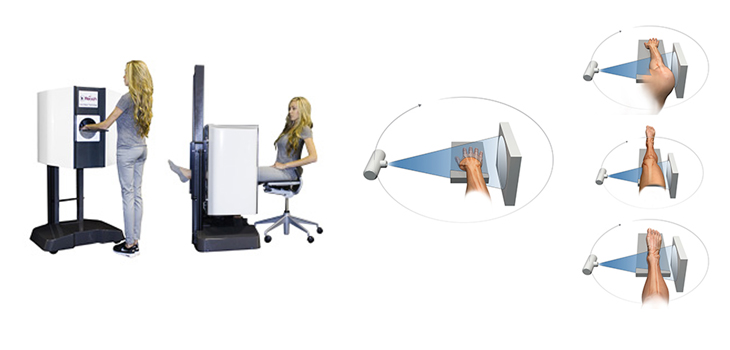
The system is designed primarily for the hand, wrist and elbow; and lower extremities in non-weight bearing positions. The company says its ideal for the point-of-care because of its small footprint, self-shielding design, and standard power equipment. “Point-of-care 3D imaging allows for faster diagnosis and more accurate treatment plans,” states the company press release. “The InReach is the most compact orthopedic extremity CT scanner available.”
A patient’s hand, wrist or elbow is positioned in a height-adjustable bore while in a standing or sitting position. The unit also accommodates non-weight bearing, lower limb imaging. Scan times are less than 30 seconds.
The company claims to be “the leader” in weight-bearing extremity CT imaging, starting with the introduction of its first product, the pedCAT, in 2012. The pedCAT, according to the company, is the only CT system that allows for bilateral, true weight bearing imaging of the lower extremities. The pedCAT was cleared by the FDA in April 2012 and received CE Mark approval in September 2013.
The InReach is supplemented by the company’s custom visualization software, called CubeVue. The company says CubeVue gives orthopedic specialists “unprecedented access to multi-planar slices and vivid 3D renderings of the anatomy previously not easily accessible to specialists. CubeVue’s Insta-X feature provides Digitally Reconstructed Radiographs, potentially eliminating the need for radiographic exams altogether.”
There’s more to come.
The company says it is currently developing its next generation multi-extremity device, the LineUP, which will provide bilateral weight-bearing images of the knees in addition to feet, as well as hand, wrist and elbow. The LineUP should be submitted for FDA review by July 2017.
The private company was founded in 2009 by a core team that developed CT imaging technology for the dental, maxillofacial and ENT specialties. The company says the introduction of point-of-care Cone Beam CT imaging revolutionized that industry and was “instrumental in the advent of custom dental implants and improved practices in orthodontics and oral surgery. Today, Cone Beam CT scans are virtually the standard of care for advanced orthodontics and oral surgery treatment planning. CurveBeam hopes to set precedents in orthopedic imaging worldwide.”
Author
React:
Discussion
This is a fascinating development. In my practice we've seen similar outcomes with the revised protocol. The key differentiator seems to be patient selection criteria. Has anyone else noticed the correlation with BMI thresholds?
Great point. I'd push back slightly on the conclusion, the sample size in the cited study is too small to draw population-level inferences. That said, the directional signal is compelling and worth a larger RCT.
We implemented a similar approach last year. Early results are promising but we're still gathering 12-month follow-up data. Happy to share our protocol if anyone is interested.
Join the conversation
Orthopedic professionals are discussing this. Sign in and upgrade to read every comment and add your voice.