
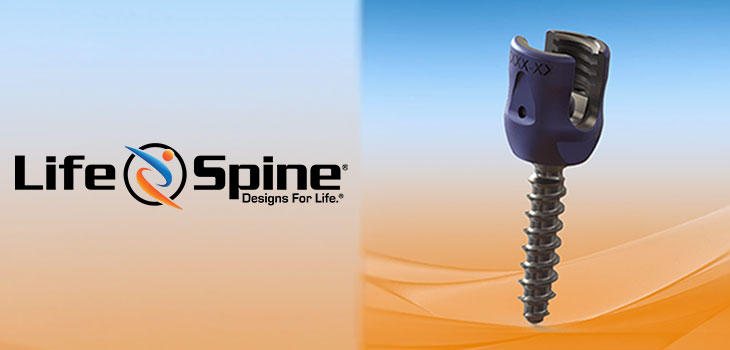
The FDA has cleared Life Spine, Inc.’s Cranial Fusion System for use with the company’s Solstice polyaxial screws for cervical spine indications.
FDA Clearance for Life Spine for Cervical Indications
2 min read Premium comments
Secondary
Mariusz Knap, the company’s vice president of marketing, said this was an exciting opportunity to use the Solstice system screws for posterior cervical fusion.
According to a May 9, 2017 announcement, the Cranial Fusion System is a multiple component system comprised of titanium alloy, with a variety of occipital plates, occipital bone screws, polyaxial screws, hooks, connectors, rods, and locking caps.
The Solstice polyaxial screws used with the cranial system come in 3.5, 4.0 and 4.5mm diameters. The conical polyaxial head angulation, says the company, facilitates easy rod placement with minimal contouring, and the “friction head” feature maintains screw head position within the surgical wound.
The Solstice system incorporates several features that make the system “uniquely designed to increase the speed, ease of use, and reliability of posterior occipito-cervico-thoracic fixation of the spine,” according to the company website.
Those features include:
- Generous polyaxial head angulation facilitates optimal screw placement
- Polyaxial “friction head” feature maintains screw head position within the surgical wound
- Pre-timed locking cap assembly reduces the chance of cross-threading
The company said in order to achieve additional levels of fixation, the cranial system may be connected to the Nautilus Thoracolumbar Pedicle Screw System using the 3.5mm/5.5mm titanium parallel connectors. The hooks and rods are also intended to provide stabilization to promote fusion following reduction of fracture/dislocation or trauma in the cervical/upper thoracic (C1-T3) spine.
Clearances and Patents
In April, the privately held company founded in 2004 and based in Huntley, Illinois, announced FDA clearance of its Plateau-C Ti Cervical Spacer System. The system entered a full market release on April 3, 2017. In September 2016, the FDA cleared the company’s Pro-Link Ti Stand-Alone Cervical Spacer System. In March 2016, the FDA gave clearance to six devices, including the Prolift Expandable Interbody System. The company had two clearances in 2015. Since its inception, the company says it has received 61 clearances from the FDA
The company launched 29 products in 2016 and revenues for the year beat the previous year by 38%. In addition to several new clearances the company also boasts of 130 issued patents
“As one of the fastest-growing, most innovative companies in our space it is important to our surgeons and patients that we continue to advance the cutting edge of technology,” said Knap after the Plateau clearance.
Author
React:
Discussion
This is a fascinating development. In my practice we've seen similar outcomes with the revised protocol. The key differentiator seems to be patient selection criteria. Has anyone else noticed the correlation with BMI thresholds?
Great point. I'd push back slightly on the conclusion, the sample size in the cited study is too small to draw population-level inferences. That said, the directional signal is compelling and worth a larger RCT.
We implemented a similar approach last year. Early results are promising but we're still gathering 12-month follow-up data. Happy to share our protocol if anyone is interested.
Join the conversation
Orthopedic professionals are discussing this. Sign in and upgrade to read every comment and add your voice.