
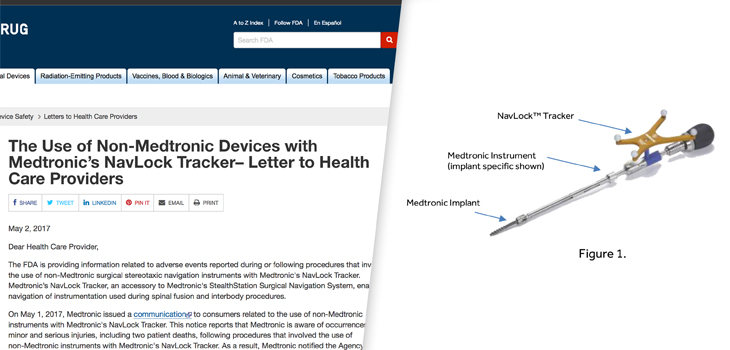
On May 1, 2017, Medtronic plc issued a communication letter cautioning healthcare providers against using the company’s NavLock Tracker with instruments not cleared to be used with the device. The company said it was updating the labeling on the device.
Deaths Spur Relabeling of Medtronic Spinal Navigation System
3 min read Premium comments
Secondary
The device is used in Medtronic’s StealthStation surgical navigation system used during spinal fusion and other procedures. The caution came after reports of patient deaths and serious injuries.
Updated Labeling
As a result, Medtronic notified the FDA of plans to update its product labeling to clarify the use of non-Medtronic instruments with its NavLock Tracker. Per Medtronic’s communication, the “Indications for Use” and “Warning” statement found in the labeling of the NavLock Tracker will be updated to state:
Revised Indications for Use: “The NavLock Trackers are intended to enable navigation of Medtronic instrumentation used during spinal fusion and interbody procedures with the Medtronic StealthStation surgical navigation system. The NavLock Trackers should only be used with Medtronic instruments.”
Strengthened Warning: “The NavLock Tracker is designed and tested for use only with Medtronic instruments. The use of non-Medtronic instruments with NavLock Tracker may result in inaccuracy, leading to serious injury or death.”
Third Party Instrument Clearances
To date, the FDA said it has reviewed and cleared surgical stereotaxic navigation instruments produced by manufacturers other than Medtronic for use with Medtronic’s StealthStation.
Among these are instruments manufactured by Alphatec Spine, Inc., Globus Medical, Inc., and Orthofix, Inc. which have been cleared for use with Medtronic’s NavLock Tracker on Medtronic’s StealthStation. The instruments from these manufacturers (e.g., third-party instruments) were cleared based on non-clinical performance data submitted to the FDA by those manufacturers.
Medical Device Reports
The FDA identified 196 medical device reports (MDRs) between January 2013 and March 22, 2017 linked to the Tracker. Spinal injury due to misplaced or misaligned screws made up the majority of the reported injuries. While the majority of the reports reportedly deal with malfunctions and do not reference the use of third-party instruments, the two reported deaths and a disproportionate number of reported injuries indicate that one or more third-party instrument was used during the procedure.
Two patient deaths, according to the FDA, happened after a procedure involving the use of third-party surgical stereotaxic navigation instruments that were not cleared for use with the Tracker or the StealthStation. The patients reportedly had postoperative hemorrhage after undergoing spinal procedures. The agency also said it is unable to determine if, or to what degree, the use of third-party instruments led to the adverse events due to the limited information included in the reports.
“FDA recognizes that the contributing factors associated with accuracy and precision problems when using stereotaxic navigation systems are multifactorial,” the agency writes.
To date, the FDA says there are no reports of patient death associated with the use of Medtronic’s Tracker when Medtronic or FDA-cleared surgical stereotaxic instruments from third-party manufacturers were used.
The majority of injuries reported to the FDA associated with the use of the Tracker, regardless of the manufacturer of the surgical stereotaxic navigation instrument used, involved spinal injury due to misaligned or misplaced screws.
FDA Recommendations
The FDA recommends health care providers:
- Do not use surgical stereotaxic instruments that have not been cleared by the FDA for use with Medtronic’s NavLock Tracker on the Medtronic StealthStation Surgical Navigation System.
- Be aware of Medtronic’s communication disclaimer related to the use of non-Medtronic surgical stereotaxic instruments with Medtronic’s NavLock Tracker.
- When using any surgical stereotaxic instruments, be aware that surgical accuracy should be assessed repeatedly throughout a procedure when using a surgical navigation system by positioning the navigated instrument tip on an identifiable anatomical landmark and comparing the actual tip location to that displayed by the system.
- Be aware that not all surgical instruments are appropriate for surgical navigation. Consider using surgical stereotaxic instruments that are identified as compatible with the surgical navigation system being used.
- Report any adverse events related to the use of Medtronic’s NavLock Tracker that come to your attention. If you suspect a problem, we encourage you to file a voluntary report through MedWatch, the FDA Safety Information and Adverse Event Reporting Program. Health care personnel employed by facilities that are subject to the FDA’s user facility reporting requirements should follow the reporting procedures established by their facilities.
- When submitting a report to the FDA, please include information related to the brand and model of all instruments used during the procedure, and what instruments were being used at the time the patient injury occurred or was suspected to have occurred. Please also provide any information on how navigation accuracy was assessed before and during the use of the instruments.
To read the FDA website update on the subject, click here.
Author
React:
Discussion
This is a fascinating development. In my practice we've seen similar outcomes with the revised protocol. The key differentiator seems to be patient selection criteria. Has anyone else noticed the correlation with BMI thresholds?
Great point. I'd push back slightly on the conclusion, the sample size in the cited study is too small to draw population-level inferences. That said, the directional signal is compelling and worth a larger RCT.
We implemented a similar approach last year. Early results are promising but we're still gathering 12-month follow-up data. Happy to share our protocol if anyone is interested.
Join the conversation
Orthopedic professionals are discussing this. Sign in and upgrade to read every comment and add your voice.