
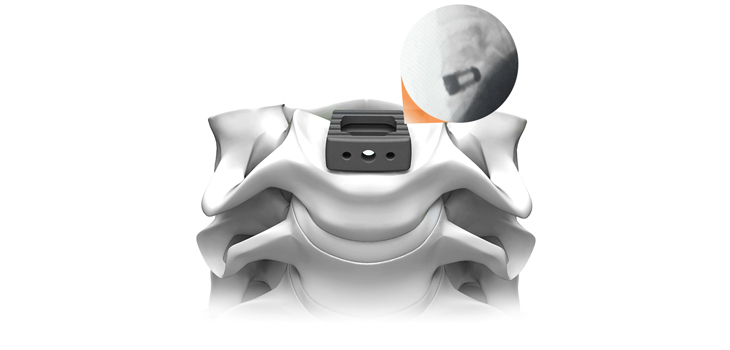
The U.S. Food and Drug Administration (FDA) has given 510(k) market clearance to Life Spine, Inc.’s PLATEAU-C Ti Cervical Spacer System.
Cervical Spacer System Cleared for Life Spine
1 min read Premium comments
Secondary
An April 19, 20917 company announcement states the system offers the company’s proprietary titanium surface technology, OSSEO-LOC, which is a surface technology that helps create an environment for potential bone growth. Additionally, in comparison to its PEEK counter-part, PLATEAU-C Ti offers additional graft windows for increased visibility in-situ and bone graft containment.
PLATEAU-C Ti entered a full market release on April 3, 2017.
According to the company’s website, the cervical spacers are designed with large, open graft areas for maximum bone graft capacity. The spacers are available in parallel and lordotic versions to accommodate varying patient anatomies.
The company launched 29 products in 2016 and revenues for the year beat the previous year by 38%. It also received six 510(k) clearances for a total of 61 since inception.
Product launches in 2016 included the LONGBOW® Lateral Expandable A/P Spacer System and the PROLIFT® PLIF/TILF Expandable Spacer System.
LONGBOW is the first-to-market product that offers controlled in-situ expansion for maximum endplate coverage, minimal anatomical disruption, and post packing capabilities. Additionally, LONGBOW was selected by Orthopedics This Week for a Spine Technology Award.
PROLIFT features an all titanium implant that restores disc height, in situ, for minimally invasive PLIF and TLIF. Furthermore, the implant is provided pre-sterile for safety and convenience. The company claims to have the broadest, fastest growing suite of expandable products in the market.
Author
React:
Discussion
This is a fascinating development. In my practice we've seen similar outcomes with the revised protocol. The key differentiator seems to be patient selection criteria. Has anyone else noticed the correlation with BMI thresholds?
Great point. I'd push back slightly on the conclusion, the sample size in the cited study is too small to draw population-level inferences. That said, the directional signal is compelling and worth a larger RCT.
We implemented a similar approach last year. Early results are promising but we're still gathering 12-month follow-up data. Happy to share our protocol if anyone is interested.
Join the conversation
Orthopedic professionals are discussing this. Sign in and upgrade to read every comment and add your voice.