
Anterior cruciate ligament reconstruction is one of the most common orthopedic surgeries performed today, but still there is a lot of debate on whether there is a “gold standard” approach to reconstructing the anterior cruciate ligament. When creating a treatment plan for an individual patient, a surgeon has quite a few decisions to make on how best to handle the reconstruction.
ACL Reconstruction: More About Skill Than Technique
6 min read Premium comments
Hamstring anterior cruciate ligament (ACL) reconstruction or bone patellar bone graft fixation? Autograft vs. Allograft? Femoral tunnel drilling via a transtibial technique, anteromedial drilling, or outside-in drilling? Single bundle vs. double bundle? Each physician has his or her own preferred technique, but is one more superior to the others? Is there a gold standard approach to ACL reconstruction?
At the recent American Academy of Orthopedic Surgeons (AAOS) conference, Alexander E. Weber, M.D. assistant professor of clinical orthopedic surgery at the Keck School of Medicine of the University of Southern California (USC) in Los Angeles and the team physician for the USC Trojan athletes addressed this question in his instruction course lecture called, “Primary Anterior Cruciate Ligament Reconstruction (ACL-R): Getting it Right the First Time”.
Still Much to Learn
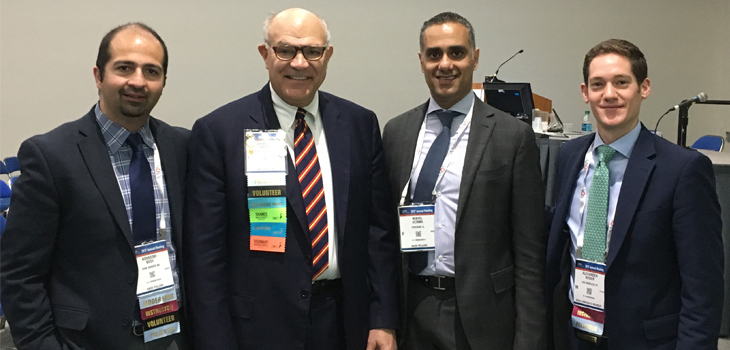
He and three of his mentors, Nikhil N Verma, M.D., associate professor, Rush University Medical Center/Midwest Orthopaedics at Rush in Chicago, Illinois and Asheesh Bedi, M.D., Harold and Helen W. Gehring Professor Chief, Sports Medicine & Shoulder Surgery MedSport, University of Michigan and team physician for the Detroit Lions, and Bernard R. Bach, Jr., M.D., Helen S. Thomson Professor, director (Emeritus) of the division of sports medicine and of sports medicine fellowship and of the department of orthopedic surgery at Rush University Medical Center discussed their own preferred approaches to ACL reconstructions.
Weber told OTW, “Some people think ACL reconstruction is pretty straightforward, but there is still a lot to learn. I wanted to have three different approaches to the same surgery in order to highlight that you can have different techniques and still get the same good results.”
Weber opened up the lecture with a discussion about portal positions and footprint visualization and how every step taken during a surgery can impact its level of success. He said that ACL reconstruction should always begin with a comprehensive bilateral lower extremity examination under anesthesia, and that even leg positioning can impact a surgeon’s success.
In discussing portal placement, he said that lateral portal should be made “high and tight” to the superolateral border of the patellar tendon to make visualization for femoral and tibial native footprints easier. A medial portal, however, should be made adjacent to the medial meniscus and two to three millimeters medial to the lateral wall of the medial femoral condyle if flexible anteromedial drilling is to be done.
Successful Despite Subjectivity
Bach centered his part of the discussion on the patellar tendon autograft harvest and transtibial ACL reconstruction.
“There have been a lot of changes in how people treat ACL, from open to arthroscopic, from allograft to autograft, where to put the tunnels. Reality is we have a good operation, most experienced surgeons, have low failure rate, low revision and reoperation, and there is a high patient subjective satisfaction level,” Bach said in an interview.
“Each patient is a little different. No one graft suits every person. The goal is to determine how to fine-tune which graft does better for different types of patients. There has been a lot of attention on how hypertension may impact the success of the ACL reconstruction.”
“There are regional differences nationally impacting which grafts are used and the patella tendon autograft is usually preferred for athletes. Each technique has its own set of advantages and disadvantages. It boils down to technique and placement of tunnels, graft fixation, and graft healing. It is a series of 20-30 steps, a well-orchestrated dance in the OR.”
Bach said, “The ACL is like the heart of sports medicine with so many injuries (200,000+ annually). People will always be trying to refine the technique BUT we have a very good operation currently.”
Bedi, on the other hand, typically prefers the anteromedial drilling technique for his ACL reconstructions. From his years of experience with this technique, he offered the following tips for a successful surgery:
- Preserve the margins of the tibial and femoral footprints to allow referencing for central tibial and femoral tunnel position.
- Anteromedial portal placement is critical. Use a spinal needle to select a portal sufficiently distant from the medial femoral condyle to avoid iatrogenic injury but with a trajectory as perpendicular to the lateral wall and femoral footprint as possible.
- The 70° arthroscope in the anterolateral portal allows excellent visualization and definition of the entire femoral footprint.
- Avoid an aggressive notchplasty. This is not necessary with the footprint technique and will often distort anatomy, eliminate the ability to reference the femoral footprint, and even compromise the length of the femoral socket.
- Modest flexion of the knee to 100° and a superolateral trajectory of the flexible guidewire are key to maximizing femoral socket length. The flexible reamer system uniquely allows for this ideal trajectory without compromising an anatomically correct intra-articular position.
- The 70° arthroscope in the anterolateral portal allows for excellent visualization during femoral footprint and tunnel preparation, graft passage, and graft fixation without the need for readjustment.
Verma helped conclude the session. He led the course through the technical aspects of femoral interference screw fixation and knee position during graft fixation with interference screw fixation.
He told OTW, “My talk focused on the history of ACL reconstruction and the fact that we are refocusing on understanding the anatomy from an arthroscopic point of view. I think it is clear that there is no ‘best in class’ technique for reconstruction. None have shown to be superior in regards to return to sport or patient outcomes.”
Verma highlighted that fixation is critical during the graft incorporation stage, but that unfortunately the exact time required to achieve biologic incorporation of ACL grafts is still unknown. According to Verma, there is also no consensus on knee position during graft fixation, and that the surgeon should always ensure full extension is achieved and that the knee is stable prior to leaving the operating room.
He also added that a single fixation device may not be available for all grafts or situations so surgeons should be familiar with multiple options if complications arise or it is a complex case.
When it comes to ensuring best success with a bone-tendon-bone graft, Verma recommended that the graft be adequately protected from high forces for 6-8 week after surgery. Soft tissue grafts however need to be protected for 12 to 16 weeks after surgery.
He said, “Allografts likely heal slower than autografts, but the variations in harvest, preparation and sterilization methods makes it difficult to provide definitive guidelines. The greatest risk of autograft injury/stretching is during the initial 6-8 weeks of remodeling.”
Anatomic vs. Conventional
Verma’s preferred technique is anatomic transtibial, which basically includes the following modifications to a traditional transtibial approach:
- moving the tibial tunnel anterior to cover the anteromedial footprint on the tibial insertion
- utilizing an over the top guide rotated to a lateral wall femoral position
- using a half reamer to allow preparation of the femoral tunnel without further posteriorization of the tibial tunnel
- rotating the patellar tendon graft such that the soft tissue position is inferior in the native footprint
More About Skill Than Approach
The biggest takeaway from the lecture was that there is no “gold standard” approach to ACL reconstruction. Ultimately, Weber said, it is more about mastering your preferred technique than it is about which technique you choose.
Verma added, “I think the key to success with ACL reconstruction is to find a technique which works well in your hands, and to make it reproducible. The focus should be on reproducing the anatomy, but standardizing your technique so you can minimize intra-operative complications.”
Author
React:
Discussion
This is a fascinating development. In my practice we've seen similar outcomes with the revised protocol. The key differentiator seems to be patient selection criteria. Has anyone else noticed the correlation with BMI thresholds?
Great point. I'd push back slightly on the conclusion, the sample size in the cited study is too small to draw population-level inferences. That said, the directional signal is compelling and worth a larger RCT.
We implemented a similar approach last year. Early results are promising but we're still gathering 12-month follow-up data. Happy to share our protocol if anyone is interested.
Join the conversation
Orthopedic professionals are discussing this. Sign in and upgrade to read every comment and add your voice.