
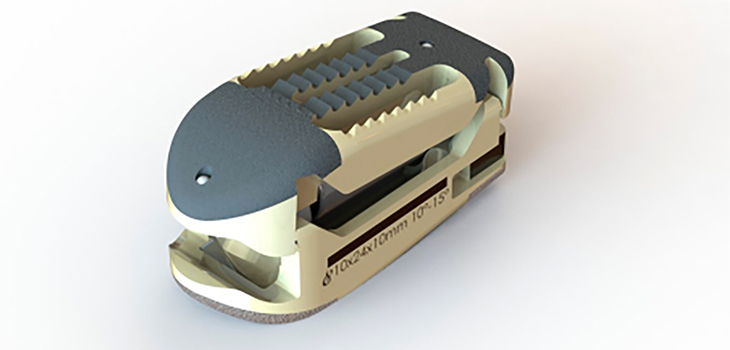
Spinal Elements, Inc., based in Carlsbad, California, has announced the successful first implantations of its Lucent XP expandable interbody implant. According to the March 20, 2017 news release, “The Lucent XP System is an interbody device that can expand in height and increase in lordotic angle after it has been surgically implanted. The height expansion helps restore the height of the spinal disc space and the lordotic angling helps correct the curvature of the spine. With the Lucent XP device, surgeons can achieve up to 15 degrees of lordotic angle, helping restore sagittal balance for the patient.”
Spinal Elements: First Procedures With Lucent Interbody Implant
2 min read Premium comments
Secondary
“The Lucent XP system is made primary of polyetheretherketone (PEEK), a radiolucent material with a lower modulus of elasticity than titanium, the primary material of many competitive systems. The PEEK mechanical properties along with the design of the device allow for a more load-sharing construct. The radiolucency allows for post-operative evaluation of the fusion progression. Additionally, the device is coated with Spinal Elements’ Ti-Bond porous titanium coating. Ti-Bond is a hydrophilic coating applied at the bone-contacting endplates of the implant.”
In the news release, Hyun Bae, M.D., a leading spine surgeon who practices at The Spine Institute in Los Angeles, California, had this to say about his experience with the Lucent XP System, “The ease of use of this system and the ability of the device to expand in height and restore lordotic angle are exactly what I need to address the challenges spinal fusion surgery for my patients.”
Paul Kim, M.D., of the Spine Institute of San Diego, added, “The clinical importance of height restoration and spinal curvature cannot be understated. Spinal Elements’ system provides these features without making sacrifices relative to construct rigidity or post-operative ability to monitor the progress of a fusion. Furthermore, I was able deploy the system safely and efficiently with a minimally invasive surgical approach.”
“Spinal Elements will be more widely launching the Lucent XP expandable interbody device in the summer of 2017. The company has seen over 20% growth of the past year in its core technologies, fueled by demand for its advanced technologies including Ti-Bond coated implants.”
Jason Blain, president of Spinal Elements, told OTW, “Spinal Elements is excited to move the expandable interbody device into production. The feedback has been overwhelmingly positive. This, in addition to our other planned launches this year (including our interspinous process device and lateral system), should help us continue to achieve the significant growth going forward that we experienced last year.”
Author
React:
Discussion
This is a fascinating development. In my practice we've seen similar outcomes with the revised protocol. The key differentiator seems to be patient selection criteria. Has anyone else noticed the correlation with BMI thresholds?
Great point. I'd push back slightly on the conclusion, the sample size in the cited study is too small to draw population-level inferences. That said, the directional signal is compelling and worth a larger RCT.
We implemented a similar approach last year. Early results are promising but we're still gathering 12-month follow-up data. Happy to share our protocol if anyone is interested.
Join the conversation
Orthopedic professionals are discussing this. Sign in and upgrade to read every comment and add your voice.