
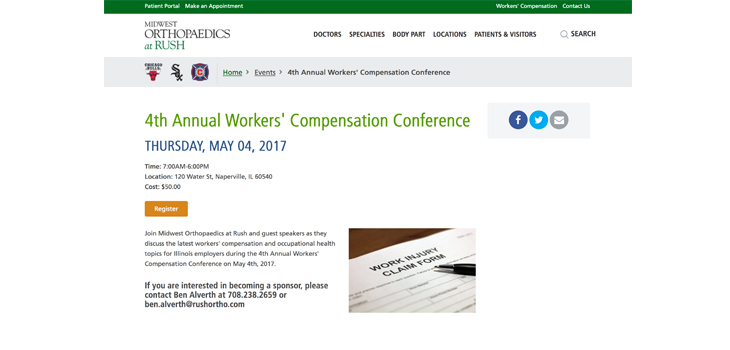
Chicago-based Midwest Orthopaedics at Rush will be hosting its 4th annual Workers Compensation Conference, Thursday, May 4, 2017. Those involved in workers’ compensation will have the chance to learn from experts on a wide range of related topics, including controlling costs, and impairment ratings. The event will be held from 8 a.m. to 4 p.m., at the Hotel Indigo, 120 Water St., Naperville. Athletico Physical Therapy and H-Wave are Gold Level sponsors for this event.
Rush: 4th Annual Workers’ Compensation Conference
1 min read Premium comments
Secondary
According to the April 5, 2017 news release, the topics and presenters will include:
- Creating an Award Winning Workers’ Compensation Program (Jennifer Saddy, American Airlines)
- Controlling Workers Compensation Costs (John Koehler, Physicians Immediate Care)
- Engineering an Effective Workers’ Compensation Program (Juan Carlos Lopez, UPS and Shuaib Ahmed, Owner & Managing Attorney, ASA Law Group)
- Illinois Workers’ Compensation: IME’s [Independent Medical Exams] and Impairment Ratings (Nikhil Verma, M.D., Midwest Orthopaedics at Rush)
- Carpal Tunnel Injuries in the Workplace (Robert Wysocki, M.D., Midwest Orthopaedics at Rush)
- The Anatomy of a Permanent and Total Disability Claim (Guy Maras, Hennessy & Roach and Ian Elfenbaum, Elfenbaum, Evers & Amarilio)
Dr. Nikhil Verma told OTW, “My presentation will highlight the changing climate for managing workers compensation in Illinois. Specifically, I will cover the 2011 reforms, the problems and challenges with managing these patients, and steps we can take to minimize cost and optimize outcomes. In addition, I will highlight the new use of impairment ratings, how they are done and what they mean.”
Interested parties may register on-line or visit www.rushortho.com.
Author
React:
Discussion
This is a fascinating development. In my practice we've seen similar outcomes with the revised protocol. The key differentiator seems to be patient selection criteria. Has anyone else noticed the correlation with BMI thresholds?
Great point. I'd push back slightly on the conclusion, the sample size in the cited study is too small to draw population-level inferences. That said, the directional signal is compelling and worth a larger RCT.
We implemented a similar approach last year. Early results are promising but we're still gathering 12-month follow-up data. Happy to share our protocol if anyone is interested.
Join the conversation
Orthopedic professionals are discussing this. Sign in and upgrade to read every comment and add your voice.