
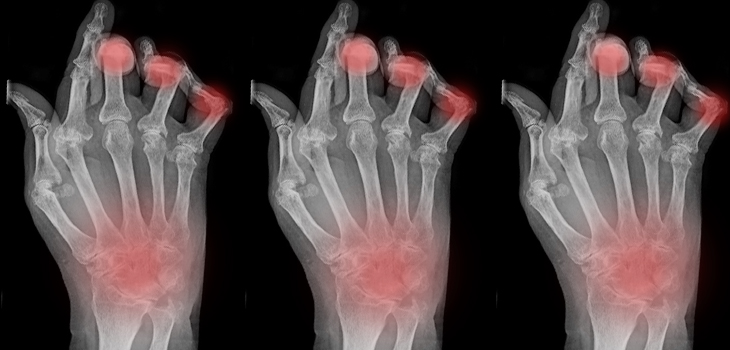
New research published in the journal Annals of the Rheumatic Diseases has found that antibodies that work against the cartilage protein collagen II are associated with a good prognosis. The article was entitled, “Anticollagen type II antibodies are associated with an acute onset rheumatoid arthritis phenotype and prognosticate lower degree of inflammation during 5 years follow-up.”. The researchers were from Uppsala University and Karolinska Institute, both in Sweden.
RA: New Options for Prognosis, Therapy
2 min read Premium comments
Secondary
“Analysing these antibodies, in combination with other relevant antibodies, could be used for predicting prognosis and choosing therapy for rheumatoid arthritis patients,” says study leader Johan Rönnelid, M.D., Ph.D. of Uppsala University, in the March 23, 2017 news release.
The team followed a large group of rheumatoid arthritis (RA) patients for five years to see if there is a correlation between the collagen antibodies and disease development.
“We found that patients with collagen antibodies showed increased signs of inflammation during the first six months after diagnosis, after this there was no difference compared to patients without any collagen antibodies. We also discovered that the presence of collagen antibodies at the time of diagnosis was associated with a better prognosis, says Vivek Anand Manivel, Ph.D. student at the Uppsala Department of Immunology, Genetics and Pathology and first author of the article.
Rönnelid told OTW, “This is the work of my second Ph.D. student, Mohammed Mullazehi. In 2006 we described how anti-collagen type II antibodies (anti-CII) can form surface-bound immune complex which very effectively stimulate production of pro-inflammatory cytokines TNF-alpha, IL-1beta and IL-8/CXCL8. We showed that these cytokines were produced by monocytes/macrophages and mediated via a specific Fc(gamma) receptor (FcgRIIa).”
“One year later we showed that anti-CII levels were very high in a small subgroup of RA patients at the time of RA onset, but thereafter declined during the first year after diagnosis. Acute inflammation, probably driven by the anti-CII-containing immune complexes, followed anti-CII levels in serum very closely. Anti-CII positive patients also have more radiological erosions at the time of diagnosis but not later as compared to anti-CII negative patients. This acute onset phenotype is the opposite of the anti-citrullinated peptide antibody (ACPA) associated phenotype where patients with and without ACPA do not differ significantly in disease activity at the time of diagnosis, but where ACPA positive patients have a worse prognosis during the following years.”
“My present Ph.D. student, Vivek Anand Manivel, has also performed functional in vitro studies showing the importance of neutrophil granulocytes in the acute onset RA phenotype driven by anti-CII. We therefore think that neutrophil granulocytes are important in this acute onset RA phenotype associated with anti-CII.
“I regard the prognostic findings, and the relative strength of the anti-CII-associated early onset RA phenotype being the two most important in the present paper. Anti-CII positive patients seem to have a good prognosis as compared to patents without anti-CII. On the contrary, patients with ACPA seem to have a bad prognosis as compared to patients without ACPA.”
Author
React:
Discussion
This is a fascinating development. In my practice we've seen similar outcomes with the revised protocol. The key differentiator seems to be patient selection criteria. Has anyone else noticed the correlation with BMI thresholds?
Great point. I'd push back slightly on the conclusion, the sample size in the cited study is too small to draw population-level inferences. That said, the directional signal is compelling and worth a larger RCT.
We implemented a similar approach last year. Early results are promising but we're still gathering 12-month follow-up data. Happy to share our protocol if anyone is interested.
Join the conversation
Orthopedic professionals are discussing this. Sign in and upgrade to read every comment and add your voice.