
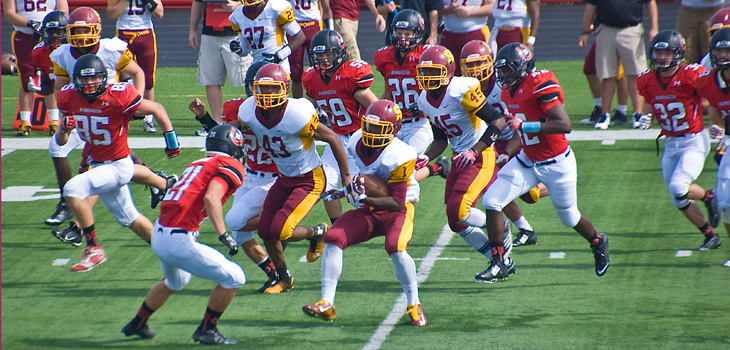
The lights in the football stadiums illuminate small towns across rural America on Friday nights where helmeted teens battle for regional football championships. Everyone in towns lit up by the lights from the football stadium comes out to watch the boys play. However, one individual who is not present is someone with the expertise to quickly diagnose and treat head injuries to the players.
No Trainer? No Problem. Robots Can Fill In
1 min read Premium comments
Secondary
A first-of-its-kind study from the Peter O’Donnell Jr. Brain Institute and Mayo Clinic reveals that technology presently exists to solve this problem. By using a remote-controlled robot, a neurologist sitting in his office hundreds of miles from the football field can evaluate athletes for concussion with the same accuracy as on-site physicians.
The study supports the movement to utilize teleconcussion equipment at all school sporting events where neurologists or other concussion experts are not immediately accessible. “I see teleconcussion being applicable anywhere in the world,” said Bert Vargas, M.D., the study’s lead author, who directs the sports neuroscience and concussion program at the O’Donnell Brain Institute at University of Texas (UT) Southwestern Medical Center. “Right now there’s a significant disparity in access to concussion expertise,” he said.
An important part of protecting against long-term injuries, Vargas said, is having personnel on hand to quickly identify and remove concussed players from games. Across the country, and especially in rural areas, more than half of the public high schools do not have athletic trainers available to spot such incidents. This increases the chances that a player’s concussion could go unnoticed and be exacerbated by additional injuries.
Vargas’ research is the first to measure how accurately telemedicine, using standard sideline concussion evaluation tools, can diagnose concussions at sporting events. According to UT Southwestern press release, the study, published in Neurology used a mobile robot that was stationed for two seasons on the sideline and athletic training room of Northern Arizona University’s football games. A neurologist could view the game from the robot’s camera and make evaluations of players who may have been concussed.
Author
React:
Discussion
This is a fascinating development. In my practice we've seen similar outcomes with the revised protocol. The key differentiator seems to be patient selection criteria. Has anyone else noticed the correlation with BMI thresholds?
Great point. I'd push back slightly on the conclusion, the sample size in the cited study is too small to draw population-level inferences. That said, the directional signal is compelling and worth a larger RCT.
We implemented a similar approach last year. Early results are promising but we're still gathering 12-month follow-up data. Happy to share our protocol if anyone is interested.
Join the conversation
Orthopedic professionals are discussing this. Sign in and upgrade to read every comment and add your voice.