
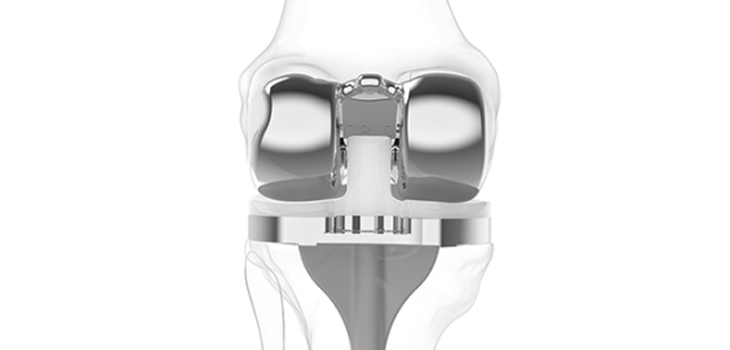
ConforMIS, Inc., headquartered in Billerica, Massachusetts, has announced results from the first study of its iTotal PS total knee replacement. The research, supported by ConforMIS, was presented in late March at the 2017 British Association for Surgery of the Knee (BASK) Annual Meeting in Southport, England.
Customized Knee Implant Study: Above Average ROM
2 min read Premium comments
Secondary
Scientists from The Center for Musculoskeletal Research at the University of Tennessee compared the knee motion of patients implanted with a ConforMIS iTotal PS customized total knee replacement to patients implanted with an off-the-shelf Zimmer Biomet NexGen PS total knee replacement.
According to the April 11, 2017 news release, “…researchers assessed the kinematics of 31 patients (13 patients with a ConforMIS iTotal PS implant and 18 patients with an off-the-shelf implant) at least six months after surgery using advanced real-time mobile x-ray imaging and 2D-3D registration. Patients who received a ConforMIS iTotal PS demonstrated greater average range of motion during a deep knee bend (112° vs. 94°). Additionally, iTotal PS patients saw greater lateral femoral rollback (11.73mm vs. 4.69mm), medial translation (2.8mm vs. 1.0mm) and greater axial rotation (10.85° vs. 7.58°) during deep knee bend, which is consistent with normal knee motion.”
“All findings from this study suggest that the iTotal PS has the kinematic and functional benefits that have been demonstrated with iTotal CR compared with traditional, off-the-shelf implants,” said William Kurtz, M.D., chief of orthopedics at St Thomas Hospital in Nashville, Tennessee, and clinical investigator in the study. “Patients want to return to everyday activities after their recovery and, in my experience, maintaining normal knee motion is critical to achieving those goals. I have found that when you alter patients’ normal kinematics, as happens with off-the-shelf implants, there’s a greater risk that the patient won’t be able to return to their regular activities.”
Two other ConforMIS-backed studies were presented at BASK. One was, according to the news release, a “retrospective review of 24,042 CT data sets used to design customized iTotal implants found that 61% of knees exhibited a distal femoral offset of >1mm. Additionally, 83% exhibited >2mm of posterior condylar offset. Off-the-shelf implants are designed with fixed condylar offsets, which are unable to retain the natural condylar shape of the knee.”
“A similar analysis was conducted on tibial implants and found that the tibial trays were within 2mm or less of symmetrical only 12% of the time, while 22% were found to have asymmetry >5mm. The authors concluded that tibial trays that are either symmetric or have a fixed asymmetry based on medio-lateral size, as off-the-shelf implants do, may face challenges between maintaining proper rotation and adequate coverage.”
Dr. Kurtz commented to OTW, “The most exciting thing is that the normal knee kinematics with the custom implant increased the patients’ overall flexion and range of motion.”
Asked how he hopes it will change the way surgeons do this procedure, he told OTW, “As more information comes out about improved kinematics with the custom knee, surgeons will be more willing to adopt the new technology.”
Author
React:
Discussion
This is a fascinating development. In my practice we've seen similar outcomes with the revised protocol. The key differentiator seems to be patient selection criteria. Has anyone else noticed the correlation with BMI thresholds?
Great point. I'd push back slightly on the conclusion, the sample size in the cited study is too small to draw population-level inferences. That said, the directional signal is compelling and worth a larger RCT.
We implemented a similar approach last year. Early results are promising but we're still gathering 12-month follow-up data. Happy to share our protocol if anyone is interested.
Join the conversation
Orthopedic professionals are discussing this. Sign in and upgrade to read every comment and add your voice.