
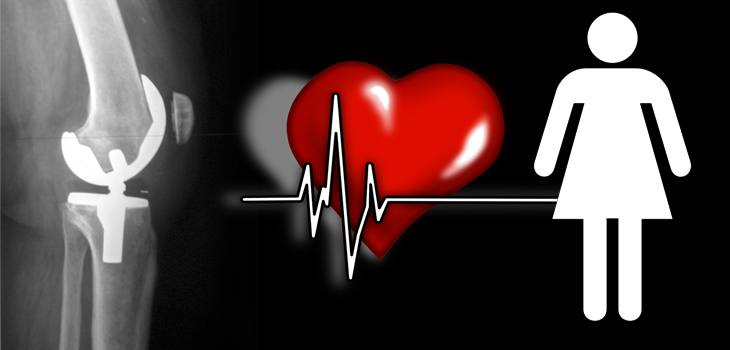
After examining a national database of 55,000 patients, researchers from the Icahn School of Medicine at Mount Sinai, New York have determined that women are less likely to have complications such as heart attack or stroke when compared to men when undergoing total joint arthroplasty (TJA).
Women Less Likely to Experience Heart Attack, Stroke, After TJA
1 min read Premium comments
Secondary
Darwin Chen, M.D. is assistant professor of orthopedics at the Icahn School of Medicine at Mount Sinai. He told OTW, “Total hip and knee replacement surgery are among the most commonly performed orthopedic procedures today. Although success rates are high, complications can occur and some may be preventable. The goal of our research was to assess the impact of gender on complications within the first 30 days after hip and knee replacement.”
“We looked at a large national database (National Surgical Quality Improvement Program) and assessed 54,502 patients undergoing THA [total hip arthroplasty] and 87,177 patients undergoing TKA [total knee arthroplasty]. After both hip and knee replacement, female gender was found to be protective of mortality, sepsis, cardiovascular events, unplanned reintubation, and renal complications. Female gender was an independent risk factor for urinary tract infections, needing a blood transfusion, and discharge to a rehabilitation facility.”
Asked what some orthopedic surgeons may not understand about these different risks, Dr. Chen noted, “Males and females have different postoperative risks for unclear reasons. Some theories include differences in preoperative hemoglobin levels, home support systems, pain tolerance, and other comorbid medical conditions.”
“The postsurgical risks after hip and knee replacement are different between men and women. When we counsel our patients before surgery, gender should play a role in the discussion.”
Author
React:
Discussion
This is a fascinating development. In my practice we've seen similar outcomes with the revised protocol. The key differentiator seems to be patient selection criteria. Has anyone else noticed the correlation with BMI thresholds?
Great point. I'd push back slightly on the conclusion, the sample size in the cited study is too small to draw population-level inferences. That said, the directional signal is compelling and worth a larger RCT.
We implemented a similar approach last year. Early results are promising but we're still gathering 12-month follow-up data. Happy to share our protocol if anyone is interested.
Join the conversation
Orthopedic professionals are discussing this. Sign in and upgrade to read every comment and add your voice.