
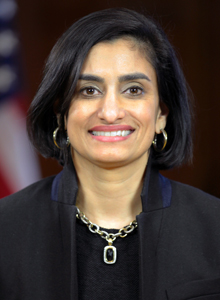
With the March 13, 2017 U.S. Senate approval of Indiana healthcare consultant Seema Verma to head the Centers for Medicare and Medicaid Services (CMS), President Trump has put in place his top Obamacare Busters.
Seema Verma – New CMS Boss
2 min read Premium comments
Transforming Medicaid
The White House wants to turn Medicaid into a block grant program whereby states receive a lump sum from the federal government to design and run their own Medicaid programs. Verma has extensive experience at the state level.
Verma designed Indiana’s Medicaid expansion program under Obamacare while Vice President Pence was governor of the state.
CMS is a $1 trillion agency that oversees health insurance programs for more than 130 million people. Orthopedic device companies and surgeons are particularly impacted by CMS coverage decisions as to what services and procedures will be paid for with federal dollars.
Verma has been critical of Medicaid, stating the “the status quo is not acceptable” for the federal-state insurance program that covers more than 70 million low-income people.
The Associated Press reported on March 13, 2017 that while in Indiana, Verma “designed a Medicaid expansion along conservative lines for Pence. Most beneficiaries are required to pay modest premiums. And the program uses financial rewards and penalties to steer patients to primary care providers instead of the emergency room. Critics say the plan has been confusing for beneficiaries and some have incurred penalties through no fault of their own.”
At her confirmation hearing, Verma said her approach to Medicaid is that low-income people are fully capable of making health care decisions based on rational incentives.
She will be reporting to HHS Secretary Tom Price, M.D. Some of her Senate testimony put her at odds with Price’s views on Medicare.
She said she does not support turning Medicare into a voucher plan under which beneficiaries would get a fixed federal contribution to purchase private coverage from government-regulated private insurance plans. Price is an advocate of such an approach. Medicare covers more than 56 million seniors and disabled people.
SVC Inc.
She is the founder and was CEO of SVC Inc., a health policy consulting firm.
Her consulting firm, according to her website, was the architect the Healthy Indiana Plan (HIP), the nation’s first consumer directed Medicaid program under Governor Mitch Daniels of Indiana and Governor Pence’s HIP 2.0 waiver proposal.
SVC developed many of the recent Medicaid reform programs including waivers for Iowa, Ohio, Kentucky and helped design Tennessee’s coverage expansion proposal. She also provided technical assistance to Michigan as that state implemented its Medicaid waiver. The firm also supported Iowa’s Medicaid transition to managed care, as well as supporting efforts Medicaid strategy efforts in Maine.
Prior to consulting, Verma served as vice president of Planning for the Health & Hospital Corporation of Marion County and as a director with the Association of State and Territorial Health Officials (ASTHO) in Washington D.C. She received her Master’s degree in Public Health with concentration in health policy and management from Johns Hopkins University and her Bachelor’s degree in Life Sciences from the University of Maryland.
Trump’s “Dream Team”
When, then President-elect Trump nominated Verma, he said, “I am pleased to nominate Seema Verma to serve as Administrator of the Centers for Medicare and Medicaid Services. She has decades of experience advising on Medicare and Medicaid policy and helping states navigate our complicated systems. Together, [HHS Secretary] Price and Seema Verma are the dream team that will transform our healthcare system for the benefit of all Americans.”
Author
React:
Discussion
This is a fascinating development. In my practice we've seen similar outcomes with the revised protocol. The key differentiator seems to be patient selection criteria. Has anyone else noticed the correlation with BMI thresholds?
Great point. I'd push back slightly on the conclusion, the sample size in the cited study is too small to draw population-level inferences. That said, the directional signal is compelling and worth a larger RCT.
We implemented a similar approach last year. Early results are promising but we're still gathering 12-month follow-up data. Happy to share our protocol if anyone is interested.
Join the conversation
Orthopedic professionals are discussing this. Sign in and upgrade to read every comment and add your voice.