
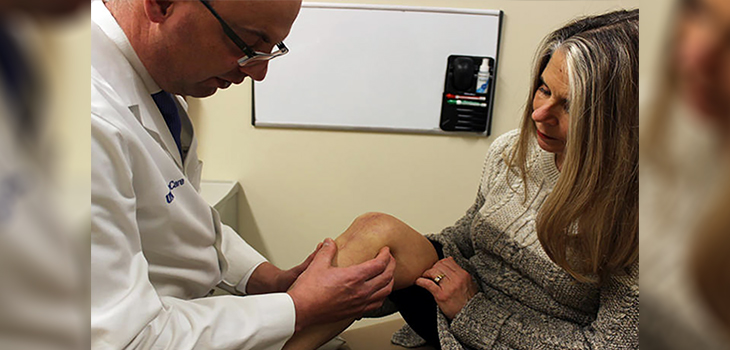
Christian Lattermann, M.D., director for Cartilage Repair and Restoration in the University of Kentucky Department of Orthopaedic Surgery and Sports Medicine, has become the first physician in Kentucky and the Midwest to perform a Matrix Associated Chondrocyte Implantation (MACI). The technology for this procedure is the first new, cartilage technology to have been approved by the U.S. Food and Drug Administration (FDA) since 1996.
New Cartilage Procedure Approved By FDA
1 min read Premium comments
Secondary
The MACI technology utilizes the patients’ own cartilage cells to create a MACI scaffold which can be glued into the cartilage defect. This technique can be done through small incisions. Less operating time is required and, according to Lattermann, patients recover more quickly. While the technology is new in the United States he says that it has a 10-year track record in Europe.
For the past decade Lattermann has worked to help the MACI procedure make its way through regulatory agencies to the point where it could receive FDA approval. At the same time Lattermann has also been performing more than 150 similar Autologous Chondrocyte Implantations, a less sophisticated version of the new procedure.
“We have been on the forefront of treating these defects for several years,” Latterman said. “Every year a couple of thousand patients in the U.S. require a true cartilage restoration and we have become a major referral center for these patients and at this point regularly serve patients from Kentucky, Tennessee, West Virginia and parts of Ohio and Indiana.”
Author
React:
Discussion
This is a fascinating development. In my practice we've seen similar outcomes with the revised protocol. The key differentiator seems to be patient selection criteria. Has anyone else noticed the correlation with BMI thresholds?
Great point. I'd push back slightly on the conclusion, the sample size in the cited study is too small to draw population-level inferences. That said, the directional signal is compelling and worth a larger RCT.
We implemented a similar approach last year. Early results are promising but we're still gathering 12-month follow-up data. Happy to share our protocol if anyone is interested.
Join the conversation
Orthopedic professionals are discussing this. Sign in and upgrade to read every comment and add your voice.