
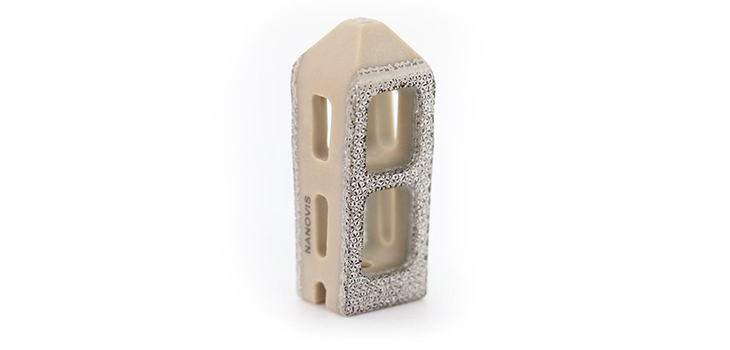
Nanovis, Inc. a life sciences company located in Columbia City, Indiana, has announced the successful alpha launch of its FortiCore PLIF featuring a deeply porous titanium scaffold interdigitated with a PEEK (polyetheretherketone) core; they are also announcing the implantation of the 2,000th FortiCore implant.
Nanovis: Launch of the FortiCore PLI, 2,000th FortiCore Implantation
2 min read Premium comments
Secondary
“My patient’s short term response to the FortiCore PLIF has been positive. I implanted the interbody using a minimally invasive technique with no problems. The shape of the implant is favorable for multiple approach options. I’m encouraged by the deep porosity of the titanium scaffold in contact with the vertebral endplate and the pre-clinical data on this technology,” said Richard B. Rodgers, M.D., Goodman Campbell Brain and Spine, a participant in the alpha launch of the FortiCore PLIF, in the February 16, 2017 news release.
“In the 18 months since I started using FortiCore my patients have been doing well. Initially, I was interested in trying to improve my patient’s outcomes by using a deeply porous titanium scaffold. I’ve been pleased with the excellent radiologic on growth seen on X-ray at 8-12 weeks and the ease of imaging bone through the PEEK core,” said Gregory Hoffman, M.D., Orthopedics North East, an early adopter of the FortiCore technology.
“Data comparing the osseointegration strength of the FortiCore scaffold, PEEK and allograft, to the strength of trabecular host bone published in Spine in October, 2016 was encouraging. One of Nanovis’ long term clinical and scientific goals is to reduce fixation related complications so we are delighted to hear positive reports from our customers about their experiences with FortiCore,” said company CEO Matt Hedrick.
Hedrick told OTW, “Surgeons don’t have to accept the bone growth problems of PEEK, or the imaging, stiffness and abrasion problems of titanium. FortiCore interbodies provide the imaging and modulus benefits of a PEEK core intermolded with a deeply porous titanium in growth and on growth scaffold. Importantly, preclinical data, published in Spine, October, 2016 and new data showed FortiCore’s osseointegration strength at 5 weeks was equivalent to mature bone and stronger than PEEK, allograft, and rough titanium.”
Asked about the product development phase, he noted, “While titanium helps bone attach, it can cause problems with imaging, subsidence, and abrasion. When our mechanical testing showed that our deeply porous titanium scaffold intermolded with a PEEK core was both durable and abrasion resistant we knew we could achieve an in-growth and on-growth interbody with the favorable modulus and imaging of PEEK without having to accept any of the problems.”
“In our preclinical research (Spine, October, 2016), we learned that FortiCore’s 5 week osseointegration strength was equivalent to the shear strength of mature trabecular bone and better than PEEK or allograft. New data shows FortiCore was also better than plasma sprayed PEEK. The research team realized that the interbody now has the potential to play a much larger role in segmental stabilization.”
Author
React:
Discussion
This is a fascinating development. In my practice we've seen similar outcomes with the revised protocol. The key differentiator seems to be patient selection criteria. Has anyone else noticed the correlation with BMI thresholds?
Great point. I'd push back slightly on the conclusion, the sample size in the cited study is too small to draw population-level inferences. That said, the directional signal is compelling and worth a larger RCT.
We implemented a similar approach last year. Early results are promising but we're still gathering 12-month follow-up data. Happy to share our protocol if anyone is interested.
Join the conversation
Orthopedic professionals are discussing this. Sign in and upgrade to read every comment and add your voice.