
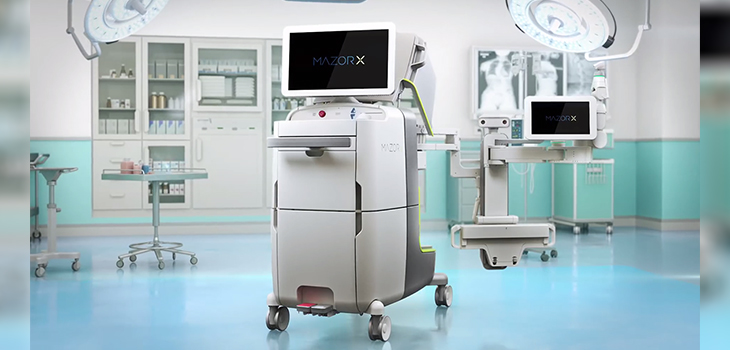
Virginia Spine Institute surgeons are the first in the Mid-Atlantic region to utilize the Mazor X System, a novel robotic platform for spine surgery. The team of Christopher Good, M.D., Thomas Schuler, M.D., and Colin Haines, M.D. were the first to have the opportunity to perform a spinal fusion with the new Mazor X System. As indicated in the February 2, 2017 news release, the Mazor X, “…utilizes enhanced analytical tools, precision guidance, optical tracking, and intra-operative verification to make spine surgery safer and less invasive. This latest advancement in spinal surgery was developed at Reston Hospital Center.”
Mazor X: Virginia Spine Institute Pioneers Use in Mid-Atlantic
2 min read Premium comments
Secondary
“I am very excited to offer the new Mazor X System’s robotic technology to our patients,” said Dr. Christopher R. Good, spine surgeon and director of Research at Virginia Spine Institute. “We are proud to have performed the first and the most advanced robotic spine surgery in the Mid-Atlantic region and to be able to offer robotic surgery to our patients both for minimally invasive spine surgery and scoliosis reconstruction. Our research is already showing that robotic surgery can decrease intra-operative radiation to patients in the operating room, as well as improve accuracy of surgery and decrease patient complications. The new Mazor X System represents the future of robotic spine surgery and will lead to many future breakthroughs by combining robotic surgery with intra-operative spinal navigation and increase the number and types of surgeries we can perform with robot guidance.”
Dr. Good told OTW, “The use of robots in spine surgery is growing rapidly with over 100 robots in use in the USA and over 125 worldwide. Robotics has been used in over 18,000 spinal procedures to place more than 120,000 implants to date. Robotics can help to decrease incision size, increase accuracy and decrease radiation in Minimally Invasive Surgery (MIS). Average decrease in fluoroscopy time per surgical case was 79% in robotic surgery.”
“Our multicenter prospective data has shown that the use of robotics decreases patient complications and decreases rates of revision surgery compared to traditional fluoroscopic spine surgical techniques.”
“The Mazor X represents a tremendous advancement in robotic spine surgery because it offers a revolutionary platform that will include improvements in pre-op surgical planning, increased number of surgical techniques that are available and with also merge the benefits of robotic guidance with the simultaneous intra-operative CT [computed tomography] navigation.”
Author
React:
Discussion
This is a fascinating development. In my practice we've seen similar outcomes with the revised protocol. The key differentiator seems to be patient selection criteria. Has anyone else noticed the correlation with BMI thresholds?
Great point. I'd push back slightly on the conclusion, the sample size in the cited study is too small to draw population-level inferences. That said, the directional signal is compelling and worth a larger RCT.
We implemented a similar approach last year. Early results are promising but we're still gathering 12-month follow-up data. Happy to share our protocol if anyone is interested.
Join the conversation
Orthopedic professionals are discussing this. Sign in and upgrade to read every comment and add your voice.