
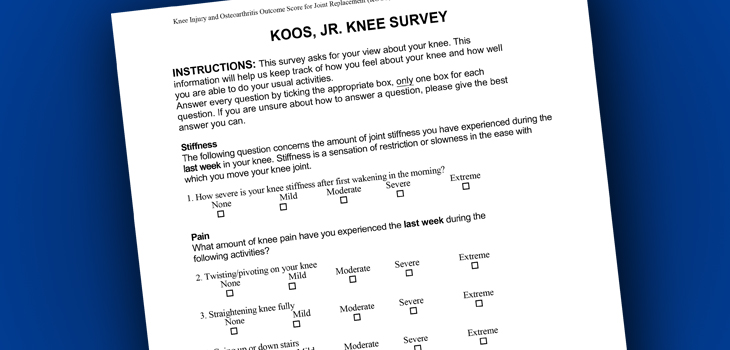
It’s a no-brainer…anyone would prefer to answer 7 survey questions as opposed to 42. Hurray for the researchers from Hospital for Special Surgery (HSS) in New York, who have confirmed that a seven-question patient survey on pain, function and quality of life is a valid and efficient tool for assessing patient outcomes following revision total knee replacement (TKR).
HSS: Shortened KOOS Is Valid!
2 min read Premium comments
Secondary
According to the March 14, 2017 news release, “The previous commonly used knee replacement survey was 42 questions often leaving physicians with partial, unusable information. The shorter survey, known as KOOS JR. (Knee Injury and Osteoarthritis Outcome Score), and its hip replacement counterpart, HOOS JR., have already been adopted for Medicare’s primary total joint replacement bundled payment program. HSS’ research presented at AAOS now provides peer-reviewed data that confirms KOOS JR. is a valid outcomes measure for knee replacement surgery.”
“At HSS, we are continually improving how we measure outcomes and KOOS JR. is a direct result of these efforts,” said Alexander McLawhorn, M.D., M.B.A., an orthopedic surgeon at HSS. “We saw a need for a shorter, more patient friendly survey in an area where outcomes data are essential to improving quality of care. In fact, knee replacement revisions, which are more complex than primary knee surgery, are under-studied in this regard.”
“With the influx of surgeries expected over the next 5 to 10 years, it is essential that we deepen our understanding of revision knee replacement outcomes,” said Steven Haas, M.D., chief of Knee Service at HSS. “This shorter patient survey will help the orthopedic community obtain necessary measurement information while minimizing the burden on patients and data collection administrators.”
“There are increasing incentives and requirements from the government and private insurers for providing patient-reported outcome measures,” said Stephen Lyman, Ph.D., director of Healthcare Research Institute at HSS. “This short form should reduce the burden and fatigue of patients in busy clinical settings when gathering this information. This study supports extending the use of KOOS JR. to patients having revision knee replacements.”
Asked about one or two particularly useful questions on the shortened KOOS, Dr. McLawhorn told OTW, “The seven questions on the shortened survey were selected from the 42-question KOOS survey. As KOOS JR. is so streamlined, each and every question is important as they all ask about knee-specific pain, function and activities of daily living, really representing a unidimensional measure of ‘knee health.’”
“This was an important first step in collecting more reliable patient-reported outcomes data on knee replacement revision surgery. Further research can be done to increase our understanding of risk stratification, infection prevention and treatment and also implant designs to improve outcomes.”
Author
React:
Discussion
This is a fascinating development. In my practice we've seen similar outcomes with the revised protocol. The key differentiator seems to be patient selection criteria. Has anyone else noticed the correlation with BMI thresholds?
Great point. I'd push back slightly on the conclusion, the sample size in the cited study is too small to draw population-level inferences. That said, the directional signal is compelling and worth a larger RCT.
We implemented a similar approach last year. Early results are promising but we're still gathering 12-month follow-up data. Happy to share our protocol if anyone is interested.
Join the conversation
Orthopedic professionals are discussing this. Sign in and upgrade to read every comment and add your voice.