
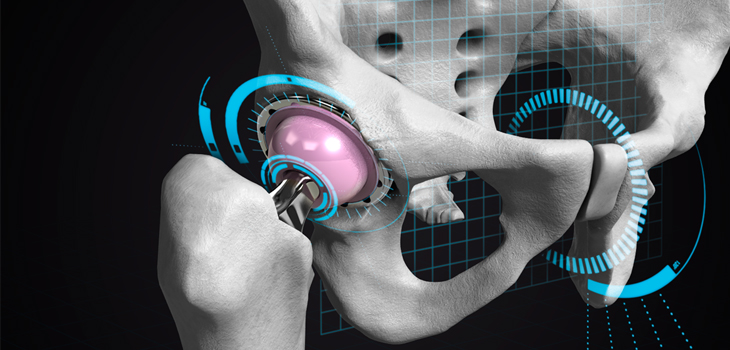
Everyone moves differently (just ask a yoga teacher!). How a person moves effects how well hip replacement “takes” after surgery. If you’ve never heard of British orthopedic company The Corin Group, you’re not alone—and you’ve probably never had a hip replacement in Australia. Corin is the little orthopedic innovation company that could, thanks to their optimized positioning system (OPS) which was quickly embraced in Australia.
Corin’s OPS: Who Needs a Robot?
2 min read Premium comments
Secondary
Now, it’s debuted in the United States.
On March 14, 2017, Corin announced the OPS snagged Food and Drug Administration (FDA) 510(k) clearance for the U.S. It might not have been the most talked-about announcement at the American Academy of Orthopaedic Surgeons (AAOS) annual meeting in San Diego, but for anyone who’s struggled with “squeaky hip syndrome,” it just might be a sanity saver.
Hips have a big job, and hip replacements have a tendency to wear out. The solution? Ceramic! However, while ceramic hip replacements don’t have the same dangers as metal, such as wearing out and sometimes leaking dangerous chemicals into the bloodstream, they can have a very annoying side effect. “Squeaky hip” complaints are popping up all over, with patients demonstrating what sounds like a dog toy squeaking away in their hip joints.
Corin’s OPS has seemingly solved the dangers of worn-out metal hip replacements and the aggravating, embarrassing issue of having strange dogs chase after patients as they squeak down the street.
Before OPS, total hip replacement (THR) required plenty of surgical skill of course, but also a generous dash of luck and gambling. Since everyone moves differently, every hip replacement should be a little different and customized for the person. Currently, there’s no consensus on one “right” pelvic plane to reference for an implant alignment. OPS lets surgeons analyze a person’s unique pelvis tilt as they move through activities of daily living.
There are two steps to OPS.
First, the OR team takes four X-rays—one anterior view, one lateral, one squatting/sitting, and one with a lifted leg. The OPS uses that data to inform a laser-guided positioning system. Corin’s specialized software creates a simulation of the person’s hip and movement patterns for the surgeon. There’s even a 3-D printed guide.
Lasers Bouncing Off the Wall
Next, a patient-specific delivery system is made by putting the 3-D guide into the patient’s acetabulum. This ensures the best positioning is accurately reproduced no matter what the patient’s position on the operating table.
The most unusual aspect of the OPS occurs when two lasers are bounced off the patient and aligned on the wall! If the two laser points aren’t perfectly overlapping, then the surgeon knows that further adjustments are necessary for an ideal alignment.
The first OPS surgery in the U.S. just happened in 2016, but over 3,000 procedures have taken place in Australia and Europe. Pretty impressive and, ahem, nothing to squeak at, for sure.
Author
React:
Discussion
This is a fascinating development. In my practice we've seen similar outcomes with the revised protocol. The key differentiator seems to be patient selection criteria. Has anyone else noticed the correlation with BMI thresholds?
Great point. I'd push back slightly on the conclusion, the sample size in the cited study is too small to draw population-level inferences. That said, the directional signal is compelling and worth a larger RCT.
We implemented a similar approach last year. Early results are promising but we're still gathering 12-month follow-up data. Happy to share our protocol if anyone is interested.
Join the conversation
Orthopedic professionals are discussing this. Sign in and upgrade to read every comment and add your voice.