
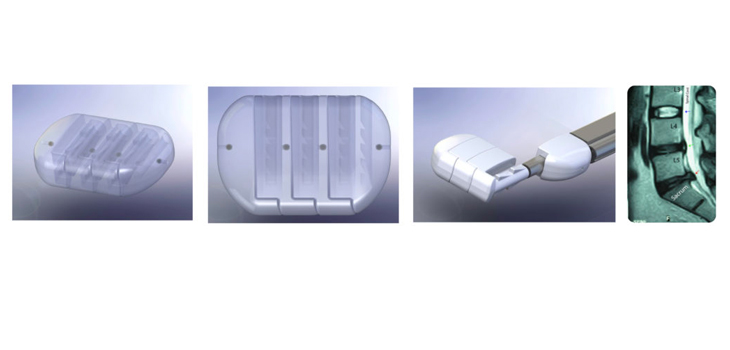
VTI (Vertebral Technologies, Inc.) has a new patent! A Minnesota-based company focused on the lumber spine solutions, VTI has been granted a new U.S. patent covering its modular, in vivo assembly technology and its motion preservation, InterCushion pipeline product.
VTI: A Patent for InterCushion
2 min read Premium comments
Secondary
“The grant of this patent expands and lengthens VTI’s protection of our unique in vivo expansion technology for minimally invasive lumbar spine solutions. VTI is a world leader in lumbar spine focused motion preservation/disc nucleus replacement technology. This patent exemplifies our continued commitment to protect and broaden our intellectual property portfolio in this space. We are encouraged by the clinical results we are seeing from clinical trials using VTI’s modular technology in our InterCushion product line,” commented Matthew R. Kyle, President and CEO of VTI, in the January 26, 2017 news release.
VTI’s InterCushion lumbar spine motion preservation product has been successful in reducing pain, preserving disc, and halting modic changes in clinical trials in Canada. Currently, several patients are at or near five years’ post implantation with continued clinically successful outcomes.
Philip de Muelenaere, an orthopedic surgeon based in Brandon, Canada, noted, “The potential value of an intervertebral nucleus replacement is linked to decreased future deterioration of the spinal motion segment. By maintaining disc height, the motion is maintained, stability is regained and long-term collapse prevented. This protects the patency of the foramina, and decreases facet arthrosis which, apart from being a pain generator, will compromise the exiting nerve root. The 5 year follow up MRI study proves that the prosthesis had maintained its position, maintained the disc height and kept the patients pain free.”
Matt Kyle commented to OTW, “VTI’s InterCushion implant design leverages the company’s patented in vivo assembly technology. In the case of the InterCushion, this equates to being able to implant a large, stable, uniform motion persevering device through a small annulotomy using MIS [minimally invasive surgery] techniques. The clinical results associated with patients at these longer-term follow up points are encouraging. This patent exemplifies our continued commitment to protect and broaden our intellectual property portfolio in this space.”
VTI Director of Marketing Brian Thron told OTW, “VTI’s marketing initiative for the next 3-6 months is to expose the brand and the company’s forward thinking technology to the spine industry and to spine surgeons who have never heard of VTI. We feel we have a great product that solves a problem for surgeons looking to do lumbar spine surgery at the L5-S1 area. We have a really cool product that is different from any other competing implants and it’s my job to get the word out to surgeons on this great technology!”
Author
React:
Discussion
This is a fascinating development. In my practice we've seen similar outcomes with the revised protocol. The key differentiator seems to be patient selection criteria. Has anyone else noticed the correlation with BMI thresholds?
Great point. I'd push back slightly on the conclusion, the sample size in the cited study is too small to draw population-level inferences. That said, the directional signal is compelling and worth a larger RCT.
We implemented a similar approach last year. Early results are promising but we're still gathering 12-month follow-up data. Happy to share our protocol if anyone is interested.
Join the conversation
Orthopedic professionals are discussing this. Sign in and upgrade to read every comment and add your voice.