
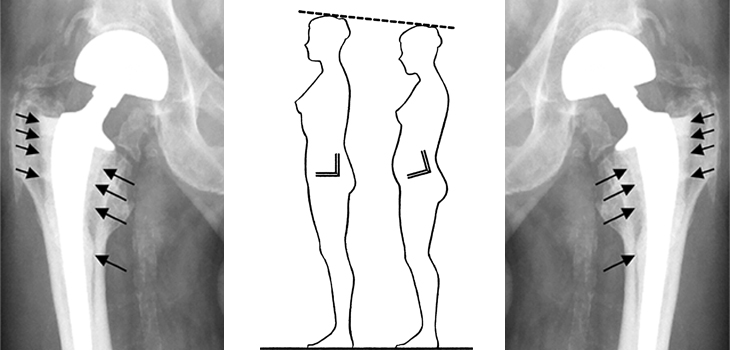
A multicenter study from Australia entitled, “Variation in functional pelvic tilt in patients undergoing total hip arthroplasty,” has found that you may be able to avoid problems with acetabular cup positioning if you do a preoperative assessment of functional pelvic position. The study appears in the February 2017 issue of The Bone & Joint Journal.
THA and Variation in Functional Pelvic Tilt
2 min read Premium comments
Secondary
The authors, who were able to measure pelvic tilt in 1,517 patients who had total hip arthroplasty (THA), set out to quantify changes in pelvic tilt between different functional positions.
The authors wrote, “The mean pelvic tilt was 4.2° (-20.5° to 24.5°), -1.3° (-30.2° to 27.9°) and 0.6° (-42.0° to 41.3°) in the three positions, respectively. The mean sagittal pelvic rotation from supine to standing was -5.5° (-21.8° to 8.4°), from supine to flexed seated was -3.7° (-48.3° to 38.6°) and from standing to flexed seated was 1.8° (-51.8° to 39.5°). In 259 patients (17%), the extent of sagittal pelvic rotation could lead to functional malorientation of the acetabular component. Factoring in an intra-operative delivery error of ± 5° extends this risk to 51% of patients.”
Jim Pierrepont, a co-author on the study, is Research and Development Manager at Optimized Ortho in Australia. He commented to OTW, “We felt the recommended guidelines for the alignment of hip arthroplasty components were inadequate. They were based off static assessments of radiographic imaging from the 1970s. Many of the failure mechanisms associated with hip arthroplasty occur when the patients are performing functional activities such as rising from a chair, bending or twisting. So it seemed a logical step to analyze patients in more functionally relevant postures if we wanted to improve the guidelines for component orientation.”
“There were two main challenges. Firstly, defining a standardized protocol for imaging the patients in the required functional postures. Secondly, the difficulty in measuring the necessary spinopelvic parameters in a controlled manner across such a large cohort of patients. Each observer needed to be very well-trained and have a lot of spare time on their hands!”
“The target orientation for acetabular component alignment needs to be adjusted for each individual, based off an analysis of the way their pelvis moves during functionally relevant activities. A pre-operative assessment of a patient’s functional pelvic position can provide valuable information to avoid the failures associated with acetabular cup mal-positioning.”
React:
Discussion
This is a fascinating development. In my practice we've seen similar outcomes with the revised protocol. The key differentiator seems to be patient selection criteria. Has anyone else noticed the correlation with BMI thresholds?
Great point. I'd push back slightly on the conclusion, the sample size in the cited study is too small to draw population-level inferences. That said, the directional signal is compelling and worth a larger RCT.
We implemented a similar approach last year. Early results are promising but we're still gathering 12-month follow-up data. Happy to share our protocol if anyone is interested.
Join the conversation
Orthopedic professionals are discussing this. Sign in and upgrade to read every comment and add your voice.