
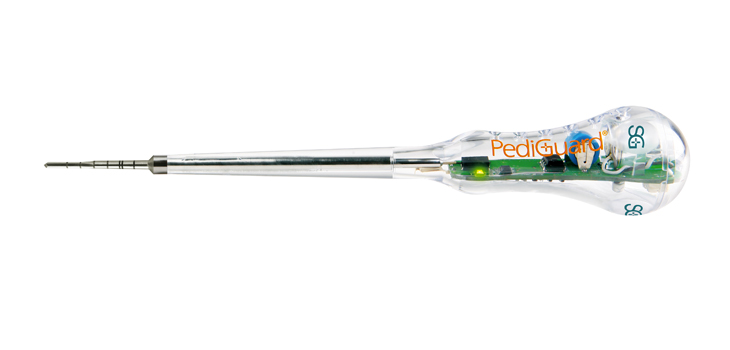
SpineGuard, an innovative company that develops and markets disposable medical devices to make spine surgery safer, announcedthat it has been granted a patent by the U.S. Patent Office for the application of its Dynamic Surgical Guidance (DSG) technology for a new application: bone quality measurement.
SpineGuard: New Patent for Bone Quality Measurement Application
2 min read Premium comments
Secondary
“Because of population aging, orthopedists and neurosurgeons are treating an increasing number of osteoporotic patients, and they are expressing the need to precisely measure the bone quality. A widely shared opinion amongst surgeons is that the existing standard of care—known as a DEXA [dual-energy x-ray absorptiometry] scan—only brings an uncertain (unreliable) answer to this growing need. This grant from the U.S. Patent Office follows previous patent grants in China and Japan. It confirms the potential of SpineGuard’s DSG technology for this very promising new application,” said Pierre Jérôme, CEO and co-founder of SpineGuard.
“We believe that the DSG technology can allow surgeons facing these skeletal pathologies to evaluate the bone density of their patients intraoperatively in a much more precise anatomical area and in doing so, to fine-tune their surgical strategy. For spine surgeries, this will ease the choice of the implants, their size, their diameter, their location and if cement should be used or not,” concluded Stéphane Bette, co-founder, CTO and U.S. General Manager of SpineGuard.
Bette told OTW, “Our recently granted new piece of IP [intellectual property] allows us to envision bringing innovative new products to the U.S. market to address significant clinical needs related to the poor quality of bone in aging population. Bringing to physicians a local and highly accurate information about patient’s bone quality can help in many situations in spinal and orthopedic surgeries, with pre-operative planning or intra-operative decisions. For example, it can impact the choice of implants for bone anchorage, or the addition of cement. Our excitement is to expand the fields of application for our unique tissue sensing technology DSG (Dynamic Surgical Guidance).”
“We just passed a major milestone in receiving the IP grant in the U.S., as in other key geographies such as China, Japan or Mexico. The other challenges are related to developing the science to back the technology, identifying the best clinical application and tool design, as well as addressing regulatory and payment aspects. We are progressing well on all these fronts. As an example, establishing by experimentation the correlation between DSG measurements and bone mineral density was a significant achievement.”
React:
Discussion
This is a fascinating development. In my practice we've seen similar outcomes with the revised protocol. The key differentiator seems to be patient selection criteria. Has anyone else noticed the correlation with BMI thresholds?
Great point. I'd push back slightly on the conclusion, the sample size in the cited study is too small to draw population-level inferences. That said, the directional signal is compelling and worth a larger RCT.
We implemented a similar approach last year. Early results are promising but we're still gathering 12-month follow-up data. Happy to share our protocol if anyone is interested.
Join the conversation
Orthopedic professionals are discussing this. Sign in and upgrade to read every comment and add your voice.