
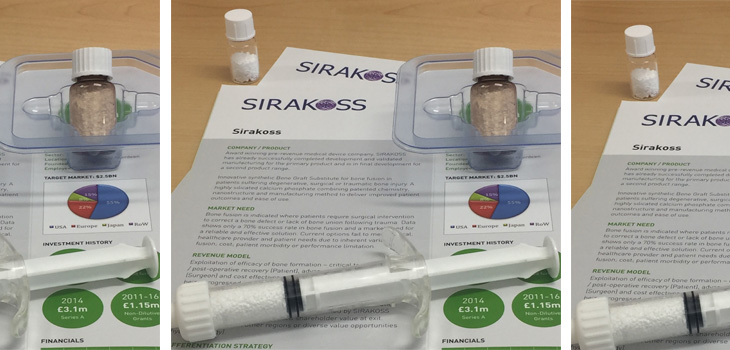
A company based in the United Kingdom—SIRAKOSS Ltd.—has announced that the United States Patent and Trademark Office has granted two patents for its bone graft technologies. As indicated in the January 27, 2017 news release, one patent “describes novel formulations of putty products, where the SIRAKOSS core technology may be combined with modified resorbable polymer carriers to produce a bone graft with improved handling characteristics and enhanced efficacy…the second patent describes a range of bone graft technologies with specific microstructural properties that expands the potential products that SIRAKOSS can develop…”
SIRAKOSS: Two New Bone Graft Patents
1 min read Premium comments
Secondary
According to the news release, “The company’s proprietary technology is entirely synthetic, containing no human tissue and can be manufactured in consistent, high quality batches. Surgeon feedback on pre-clinical performance data and handling properties of the SIRAKOSS bone graft substitutes, when compared to currently available products, has been very encouraging. The alternative approach against which all other options are measured is autograft—the ‘gold standard’—where healthy bone is harvested from the patient’s hip and replanted at the defect site. The amount of bone that is available for grafting is limited, particularly in children, and requires two invasive operative procedures, increasing the risk for the patient and the cost for the hospital. Other alternatives have seen products derived from cadaver bone, but these can be inconsistent in their performance.”
Chief Executive Brian Butchart commented to OTW, “What is particularly important about these patents is they endorse the company’s core belief in its differentiated product chemistry, architecture and manufacturing method which in turn deliver the clinically desirable product benefits.”
Author
React:
Discussion
This is a fascinating development. In my practice we've seen similar outcomes with the revised protocol. The key differentiator seems to be patient selection criteria. Has anyone else noticed the correlation with BMI thresholds?
Great point. I'd push back slightly on the conclusion, the sample size in the cited study is too small to draw population-level inferences. That said, the directional signal is compelling and worth a larger RCT.
We implemented a similar approach last year. Early results are promising but we're still gathering 12-month follow-up data. Happy to share our protocol if anyone is interested.
Join the conversation
Orthopedic professionals are discussing this. Sign in and upgrade to read every comment and add your voice.