
The numbers can seem overwhelming. According to the U.S. Centers for Disease Control, approximately one million knee and hip-replacement surgeries are performed each year in the United States alone.
OrthAlign & Analog Devices Jointly Develop Surgical Sensor
2 min read Premium comments
Secondary
The number of hip replacements, per a study presented to the American Academy of Orthopaedic Surgeons, will increase almost triple over the period from 2005 to 2025. The number of knee replacements is expected to increase by more than 650% in the same period.
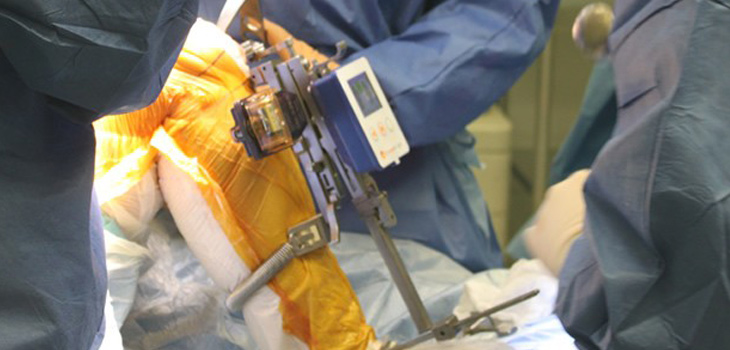
As the need for surgery increases, so does the need for surgeons and technology that can help them perform their tasks more effectively. One company responding to this situation is OrthAlign, Inc., a medical-technology company, which has developed a palm-sized, single-use device equipped with sensors from Analog Devices, Inc. Surgeons can use the device to help them navigate during surgery and more quickly and accurately align hip and knee joints.
According to the manufacturer, the OrthAlign devices provide surgical teams with real-time data and feedback about joint positioning and realignment, without the teams needing extra time or having to make an extra effort. Use of the devices is claimed to improve surgical precision while lowering costs.
“The idea was to develop something that can maintain the accuracy of [surgical] navigation, but be fast, simple, and easy to use,” says orthopedic surgeon David J. Mayman, M.D., who uses the technology in his work at the Hospital for Special Surgery in New York.
The company reports that rather than incorporating camera-based navigation into their solutions—which would add significant expense and size to a surgical navigation system—OrthAlign’s design team employs the ADI iSensor MEMS inertial measurement unit [IMU] technology. In the case of a knee replacement, for instance, IMU allows an orthopedic surgeon to determine within seconds the center of rotation of a patient’s femur. As the patient’s knee is put through a full sweep of motion, the surgeon can quickly make decisions and operate more precisely. The ADI sensors used in the devices are the same IMUs used in a variety of other products, ranging from guided missiles to drones.
The ADI technologies that are part of the OrthAlign surgical devices were first used in the automotive industry to detect the conditions necessary to trigger airbags. About a decade ago, ADI began to reposition its inertial technology for wider use in other industries, says Bob Scannell, a business development manager for ADI’s Inertial MEMS Products.
“Because of the capabilities originally driven by the automotive world, we could develop a rather unique technology base with high-performance sensors at relatively low cost,” Scannell says. “When we focused on the industrial application base, the value of our technology to this emerging need to detect precise motion in complex and safety-critical conditions quickly became clear and drove even more rapid advancements in high-performance inertial sensing.”
The compact ADI iSensor MEMS IMU device provides access to temperature-calibrated and dynamically compensated sensor data over a standard digital serial peripheral interface. This makes it possible for the user to digitally tune the sensor filtering and processing to adapt to multiple application scenarios.
Mayman observes, “As surgeons, we don’t like surprises. It’s really nice to be in the operating room and having numbers in front of you” from the device, a surgeon says. “There’s nothing worse, as a surgeon, than seeing your post-op X-ray and thinking ‘Ooh, that’s not what I thought I was doing.’ So, it’s [helpful] having that confidence to be able to move on and say, ‘I know that’s right.’”
Author
React:
Discussion
This is a fascinating development. In my practice we've seen similar outcomes with the revised protocol. The key differentiator seems to be patient selection criteria. Has anyone else noticed the correlation with BMI thresholds?
Great point. I'd push back slightly on the conclusion, the sample size in the cited study is too small to draw population-level inferences. That said, the directional signal is compelling and worth a larger RCT.
We implemented a similar approach last year. Early results are promising but we're still gathering 12-month follow-up data. Happy to share our protocol if anyone is interested.
Join the conversation
Orthopedic professionals are discussing this. Sign in and upgrade to read every comment and add your voice.