
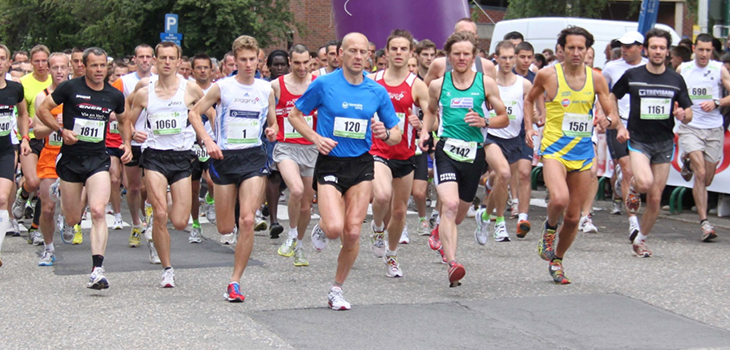
Ten people running 10 meters are actually exercising in 10 different ways. According to an important new study, we’re measuring exercise activity all wrong.
New Study: We’re Measuring Exercise all Wrong
2 min read Premium comments
Secondary
Cain C.T. Clark of the Applied Sports Technology, Exercise and Medicine (A-STEM) Research Centre and of the Engineering Behavior Analytics in Sport and Exercise (E-Base) Research group of Swansea University in Swansea, Wales and colleagues reported in the March 2017 issue of Sports Medicine that while there are some reliable methods of measuring physical activity, more refinement is needed to better understand the fundamental differences in how we exercise.
The researchers reviewed studies published between January 2010 and December 2014 that looked at emerging analytical techniques of physical activity and included technique accuracy. Out of 50 articles reviews, 11 met eligibility criteria.
From their analysis, they concluded that “despite the diverse nature and the range in accuracy associated with some of the analytic techniques, the rapid development of analytics has demonstrated that more sensitive information about physical activity may be attained. However, further refinement of these techniques is needed.”
Clark, who is now a junior lecturer at Hartpury University Centre in the United Kingdom told OTW, current techniques tend to focus on overall activity, but not the fundamental differences in activity.
“Think of it this way…If I have 10 people run 10 metres, they have all done the same amount of activity, right? I would assert no, each of those individuals would have covered those 10 metres in different ways, for some it would have been easy, for some it would have been hard, some would have used more energy, some would have less. So, there are far deeper, more fundamental issues than just how much overall.”
Clark added that the future research should focus on the lack of depth in analyzing physical activity data.
“We know how much activity people do, we know why they do or don’t, what we don’t know is, fundamentally, how people are active, and how different we are at performing the same activity (i.e., gait, movement quality, motor control). If we have more detail on how people move, we may be able to tailor and tweak interventions and initiatives to be more palatable and appropriate for everyone. This is the key, ensuring and promoting sustainable physical activity.”
Author
React:
Discussion
This is a fascinating development. In my practice we've seen similar outcomes with the revised protocol. The key differentiator seems to be patient selection criteria. Has anyone else noticed the correlation with BMI thresholds?
Great point. I'd push back slightly on the conclusion, the sample size in the cited study is too small to draw population-level inferences. That said, the directional signal is compelling and worth a larger RCT.
We implemented a similar approach last year. Early results are promising but we're still gathering 12-month follow-up data. Happy to share our protocol if anyone is interested.
Join the conversation
Orthopedic professionals are discussing this. Sign in and upgrade to read every comment and add your voice.