
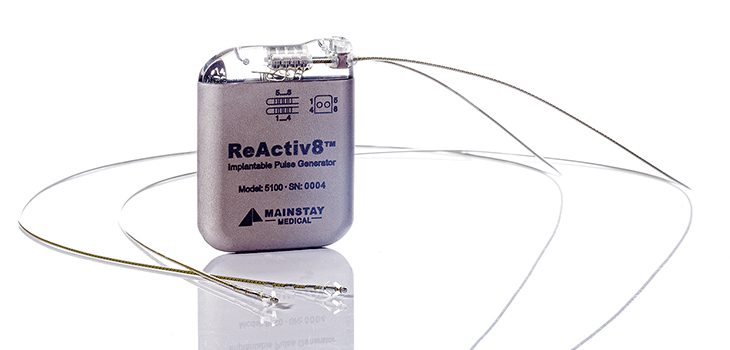
Mainstay Medical International plc has announced the first sale and implant of ReActiv8 in Germany. According to the February 1, 2017 news release, “ReActiv8 is an implantable neurostimulation system to treat disabling chronic low back pain. The ReActiv8 implant was performed by Dr. med. Francis Kilian, orthopedic and neurosurgeon at the Catholic Hospital Koblenz-Montabaur in Koblenz Germany. ReActiv8 works by electrically stimulating the nerves responsible for contracting the key stabilizing muscles of the lumbar spine. Activation of these muscles to restore functional spine stability has been shown to facilitate recovery from chronic low back pain.”
Mainstay Medical: First Sale of ReActiv8 in Germany
2 min read Premium comments
Secondary
Dr. Kilian commented, “As spine surgeons we are always looking to address the underlying cause of a patient’s condition but until now we had no effective option to offer to patients with chronic low back pain due to impaired control of their back muscles. ReActiv8 represents a significant breakthrough for this large group of patients who are not candidates for spine surgery and fills an important void in our restorative treatment portfolio.”
Asked about a challenge in moving the product to this point, Mainstay CEO Peter Crosby told OTW, “To get ReActiv8 to the point of European commercialization, we have had to run two rigorous international multicenter clinical studies. First to prove the therapeutic concept and next to build the experience, performance and safety data to support the CE marking process for ReActiv8.”
“During this time, we started to roll out communications to the spine community that providing dynamic stability to the lumbar spine is also an option for chronic low back pain patients who are not indicated for surgery. ReActiv8 combines the use of neurostimulation technology and the concept of restoring control over the muscles that provide dynamic stability to the lumbar spine which is known to facilitate recovery from chronic low back pain. It therefore addresses the root cause rather than masking the symptoms of the condition. This new therapeutic approach can be referred to as Restorative Neurostimulation.”
“The first exciting moment was when the first patient implanted in the feasibility study reported an important improvement in pain after suffering years of disabling low back pain. Similar pride and excitement we now feel with the introduction of ReActiv8 that offers the same prospect to many other similar patients. The ReActiv8-A Clinical Trial, which supported CE Marking, demonstrated a clinically important, statistically significant and lasting improvement in pain, disability and quality of life in people with disabling chronic low back pain and few other treatment options. To see ReActiv8 reach the market in Europe is enormously satisfying and we now look forward to completion of our ReActiv8-B trial and PMA submission for US approval.”
Author
React:
Discussion
This is a fascinating development. In my practice we've seen similar outcomes with the revised protocol. The key differentiator seems to be patient selection criteria. Has anyone else noticed the correlation with BMI thresholds?
Great point. I'd push back slightly on the conclusion, the sample size in the cited study is too small to draw population-level inferences. That said, the directional signal is compelling and worth a larger RCT.
We implemented a similar approach last year. Early results are promising but we're still gathering 12-month follow-up data. Happy to share our protocol if anyone is interested.
Join the conversation
Orthopedic professionals are discussing this. Sign in and upgrade to read every comment and add your voice.