
Researchers at the University of Wisconsin (UW)-Madison have just published new work on bone regeneration. The research, published online February 2, 2017 in Stem Cell Reports, contains information on two proteins found in bone marrow that are key regulators of the master cells responsible for making new bone. The study is entitled, “Identification of Bone Marrow-Derived Soluble Factors Regulating Human Mesenchymal Stem Cells for Bone Regeneration.”
Bone Marrow Proteins Regulate Bone-Building Cells
2 min read Premium comments
Secondary
“These are pretty interesting molecules,” explained Wan-Ju Li, Ph.D. a UW-Madison professor of orthopedics and biomedical engineering, in the February 2, 2017 news release. “We found that they are critical in regulating the fate of mesenchymal stem cells.”
Dr. Li worked with Tsung-Lin Tsai, a UW-Madison postdoctoral researcher, and, according to the news release, found “that exposing mesenchymal stem cells to a combination of lipocalin-2 and prolactin in culture reduces and slows senescence, the natural process that robs cells of their power to divide and grow. Li says keeping the cells happy and primed outside the body, but reining in their power to grow and make bone tissue until after they are implanted in a patient, is key.”
“To engineer the growth of new bone in the body through regenerative medicine first requires generating large amounts of good quality cells in the lab, notes Li. In the body stem cells are rare. But if cell growth, differentiation and quality can be controlled in the lab dish, it may be possible to create stocks of cells for therapeutic applications and prime them for bone regeneration once implanted in a patient.”
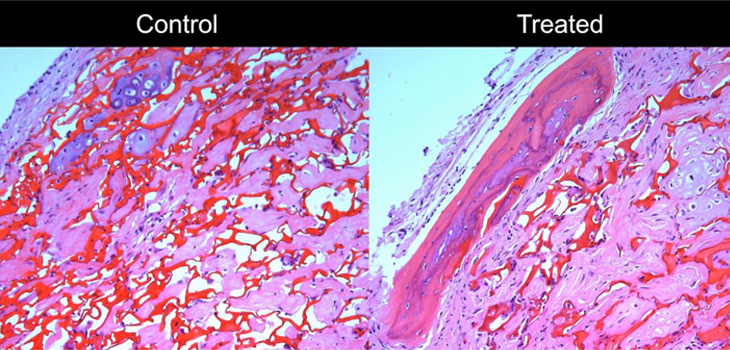
Professor Wan-Ju Li told OTW, “In this study, we have demonstrated a systematic approach to identify soluble factors of interest extracted from human bone marrow and used them in bone marrow-derived mesenchymal stem cell (BMSC) culture for tissue regeneration. We have found that lipocalin-2 and prolactin are key factors in bone marrow, involved in regulating BMSC activities. Treating the cell with lipocalin-2 and prolactin delays cellular senescence of BMSCs and primes the cell for osteogenesis and chondrogenesis. We have also demonstrated that BMSCs pretreated with lipocalin-2 and prolactin can enhance the repair of calvarial defects in mice.”
“Mesenchymal stem cells, which are bone forming cells, can maintain their properties in culture after isolated from the body by simply being exposed to the proteins extracted from bone marrow their native microenvironment. Our study provides research evidence that is in support of a potential clinical procedure by which orthopedic surgeons can use the two molecules identified in our study to treat a critical-sized bone defect.”
Author
React:
Discussion
This is a fascinating development. In my practice we've seen similar outcomes with the revised protocol. The key differentiator seems to be patient selection criteria. Has anyone else noticed the correlation with BMI thresholds?
Great point. I'd push back slightly on the conclusion, the sample size in the cited study is too small to draw population-level inferences. That said, the directional signal is compelling and worth a larger RCT.
We implemented a similar approach last year. Early results are promising but we're still gathering 12-month follow-up data. Happy to share our protocol if anyone is interested.
Join the conversation
Orthopedic professionals are discussing this. Sign in and upgrade to read every comment and add your voice.