
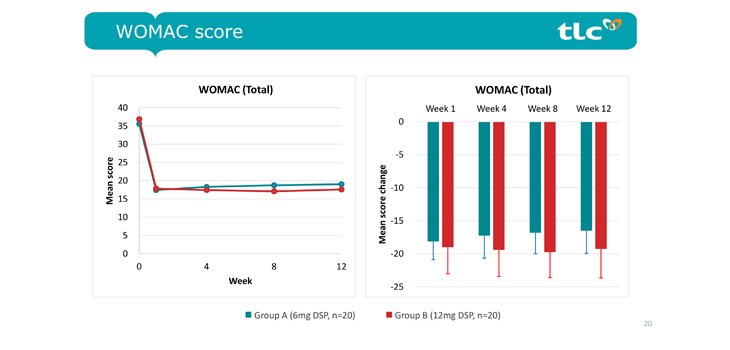
TLC (Taiwan Liposome Company) has good news for folks suffering with knee osteoarthritis (OA). The company has reported top-line results from the Phase 1/2 trial of TLC599 for sustained pain management in patients with this condition. As indicated in the January 6, 2017 news release, “The trial demonstrated a positive safety profile for a single intra-articular injection of either a 6mg or 12mg dose of TLC599. In addition, the trial demonstrated a trend of sustained, clinically meaningful decrease from baseline through week 12 in several widely-used assessments of pain. These results support the potential for TLC599 to address the problem of a limited duration of action for steroid therapy in patients with osteoarthritis.”
Taiwan Liposome Company: Positive Results for OA Injection
2 min read Premium comments
Secondary
“Aging populations across the globe are leading to an increased prevalence of osteoarthritis but current treatment options are inadequate, ” commented TLC President George Yeh. “The results of this trial demonstrate that TLC599 may address the critical issue of short duration of action that limits the therapeutic potential of corticosteroid treatments in wide use today. We are encouraged by these results as we move ahead with our Phase 2 trial. We are optimistic that TLC599 will ultimately reduce burdens for patients and the healthcare system.”
As indicated in the news release, “TLC plans to initiate a Phase 2 trial of TLC599 at sites in Taiwan and Australia, with investigational new drug (IND) approval already granted in Taiwan by the Taiwan Food and Drug Administration (TFDA). The trial will involve 24 weeks of observation following a single intra-articular injection of TLC599 and investigate sustained control of pain for three groups: placebo, 12mg and 18mg, with 24 patients in each group. WOMAC [Western Ontario and McMaster Universities Osteoarthritis Index] measurements will be conducted at regular intervals over the observation period to evaluate efficacy of pain management. Data will be un-blinded once the 24 week data are available for all 72 patients. This Phase 2 clinical trial will help to determine the sample size and the efficacy period for a pivotal trial.”
George Yeh commented to OTW, “The efficacy data from this TLC599 trial shows that not only have we achieved our target of up to 12 weeks of pain relief, the flat tail at the end of the 12 week observation period suggests the possibility of a sustaining effect longer than the 12 week period, which prompted the extension of observation period from 12 weeks to 24 weeks in our Phase 2 trial, with patient recruitment in both Taiwan and Australia. With a good safety profile, including no serious adverse events, and both fast onset and long duration, we hope to soon bring this treatment option to patients.”
React:
Discussion
This is a fascinating development. In my practice we've seen similar outcomes with the revised protocol. The key differentiator seems to be patient selection criteria. Has anyone else noticed the correlation with BMI thresholds?
Great point. I'd push back slightly on the conclusion, the sample size in the cited study is too small to draw population-level inferences. That said, the directional signal is compelling and worth a larger RCT.
We implemented a similar approach last year. Early results are promising but we're still gathering 12-month follow-up data. Happy to share our protocol if anyone is interested.
Join the conversation
Orthopedic professionals are discussing this. Sign in and upgrade to read every comment and add your voice.