
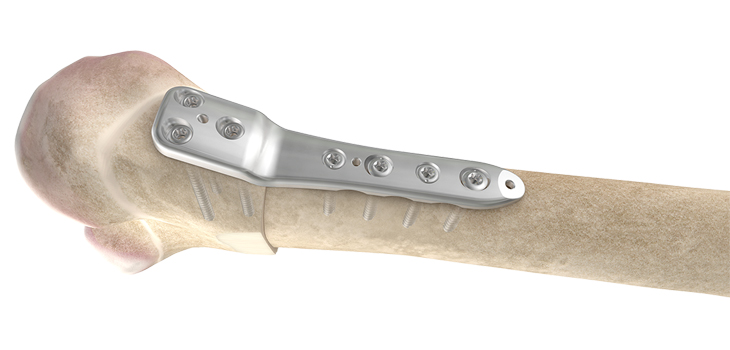
“OrthoPediatrics Corp. is pleased to announce the launch of its new Distal Femoral Osteotomy System (DFOS). The system includes implants to treat several different distal femoral conditions, including flexion contracture which is common in patients with Cerebral Palsy. Additionally, the system can be used to correct varus and valgus knee deformities. The instrumentation includes a pin guide and cut guides, which reference the femur and tibia, making the bone cuts and implant placement more accurate and reproducible.”
OrthoPediatrics Launches Distal Femoral Osteotomy System
1 min read Premium comments
Secondary
Joe Hauser, OrthoPediatrics’ Vice President of Trauma and Deformity Correction, said in the January 4, 2016 news release, “Pediatric orthopedic limb deformity correction cases can be challenging, often relying on a systems’ implants and instruments to lead and guide the surgical procedure. With our new, pediatric specific DFOS, surgeons now can choose from a wide variety of plate designs to perform extension osteotomies and address coronal plane deformity correction procedures while using innovative instruments and reproducible cutting block designs.”
“Pediatric Orthopedic Surgeon, Scott Hoffinger, M.D. at Lucille Packard Hospital in California performed the first surgery with the new system on December 6, 2016, saying, ‘The new system makes the procedure more precise. The instrumentation allows the surgeon to prepare the bone using the patient’s own anatomical landmarks.’
David Bailey, Executive Vice President of OrthoPediatrics, told OTW, “The year 2016 was very exciting for OrthoPediatrics, with strong sales growth in all three segments of our business (Trauma and Deformity, Spine, and Sport Medicine). Several new product launches, including DFOS and our BandLoc system added to the company’s expansive portfolio of pediatric-specific products, and are delighting our customers and their patients every day. We have a robust pipeline of new technologies and our continued expansion outside the U.S. is thrilling.”
React:
Discussion
This is a fascinating development. In my practice we've seen similar outcomes with the revised protocol. The key differentiator seems to be patient selection criteria. Has anyone else noticed the correlation with BMI thresholds?
Great point. I'd push back slightly on the conclusion, the sample size in the cited study is too small to draw population-level inferences. That said, the directional signal is compelling and worth a larger RCT.
We implemented a similar approach last year. Early results are promising but we're still gathering 12-month follow-up data. Happy to share our protocol if anyone is interested.
Join the conversation
Orthopedic professionals are discussing this. Sign in and upgrade to read every comment and add your voice.