
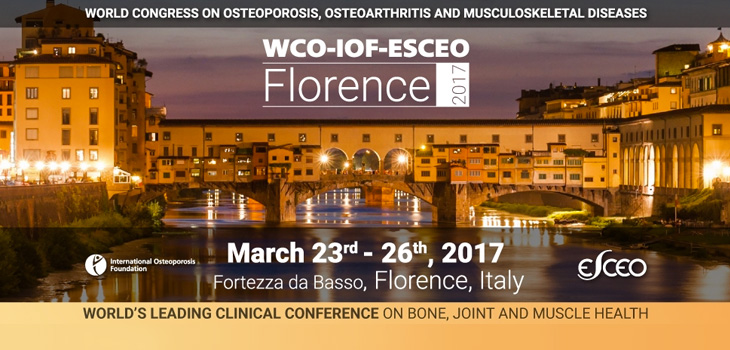
Soon, approximately 5, 000 attendees will converge upon Florence, Italy, for the annual joint Congress of the International Osteoporosis Foundation (IOF) and European Society for Clinical and Economic Aspects of Osteoporosis, Osteoarthritis and Musculoskeletal Diseases (ESCEO). The event, to be held from March 23-26, 2017, will welcome the world’s leading experts in the bone, muscle and joint field.
IOF: Italy Meeting to Cover Bone, Muscle and Joint Advances
2 min read Premium comments
Secondary
According to the news release, “The Congress is a key opportunity for investigators to present their new clinical research at a global forum that brings together key opinion leaders, leading researchers and clinicians from all regions of the world. The Congress is Co-chaired by Professor John Kanis (IOF President) and Professor Jean-Yves Reginster (ESCEO). The Scientific Programme Committee is headed by Professors René Rizzoli (ESCEO) and Professor Cyrus Cooper (IOF).”
- “Accepted abstracts, which must be submitted by January 13, 2017, will be published in a supplement issue of the leading journal ‘Osteoporosis International’. In 2016 more than 1250 abstracts were submitted and more than 50 noteworthy abstracts were invited as oral presentation; all abstracts invited for presentation as posters. http://www.wco-iof-esceo.org/abstracts
- Various grants are available for young investigators. Information about grants and awards can be found here: http://www.wco-iof-esceo.org/awards
- The Congress has been granted 15 European CME credits by the EACCME. The complete scientific programme can be viewed at http://www.wco-iof-esceo.org/thursday-23
- Pre-registration deadline is March 6th : online registration is available here”
Professor JY Reginster, congress co-chair and president of ESCEO, commented to OTW, “In addition to a wide range of topics related to clinical management and new developments in osteoporosis and osteoarthritis, this year’s Congress will also focus on several hot topics of importance to the orthopaedic community. Frailty and sarcopenia, a major cause of falls leading to fractures, and a topic of growing concern giving the ageing of the population, will be discussed in various sessions. In addition, a special symposium will be entirely dedicated to the identification and management of patients at imminent risk of osteoporotic fracture, an emerging area of research which should be of great interest to orthopedists. We’re also proud that, due to the strong relationship between ESCEO and WHO [World Health Organization], the Congress has been chosen for the launch of the Integrated Care for Older People (ICOPE) Guidelines issued by the WHO. During the Opening Ceremony representatives from the WHO and the European Medicines Agency will present their views on the importance of healthy musculoskeletal ageing.”
Asked how they would know that the event is a success, he responded, “Despite a less than optimal economic climate in recent years, I am proud to say that the IOF-ESCEO annual Congress has a great track record. It has become the largest congress in the musculoskeletal field and there has been a steady increase in the number of high quality research abstracts received from one year to the next—in fact last year more than 1, 200 were submitted! Although this milestone will be difficult to beat, we’re very pleased that, so far, it appears that the 2017 Congress in Florence may attract even more delegates and abstract submissions. Beyond the statistics, success is also measured by the Congress’ continued reputation as a key platform for the communication of new developments in clinical care and as a top forum at which delegates and key opinion leaders can evolve or establish new global collaborations in research.”
Author
React:
Discussion
This is a fascinating development. In my practice we've seen similar outcomes with the revised protocol. The key differentiator seems to be patient selection criteria. Has anyone else noticed the correlation with BMI thresholds?
Great point. I'd push back slightly on the conclusion, the sample size in the cited study is too small to draw population-level inferences. That said, the directional signal is compelling and worth a larger RCT.
We implemented a similar approach last year. Early results are promising but we're still gathering 12-month follow-up data. Happy to share our protocol if anyone is interested.
Join the conversation
Orthopedic professionals are discussing this. Sign in and upgrade to read every comment and add your voice.