
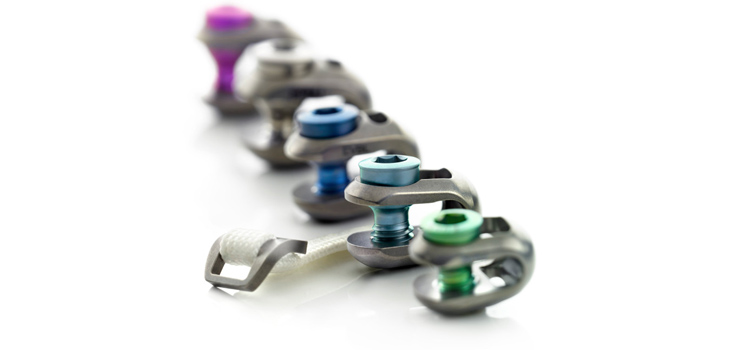
Implanet, based in Bordeaux, France, has announced that the European Patent Office (EPO) has granted it a European patent for its JAZZ implant’s universal tensioning system. The company, which is focused on knee and spine, also has a U.S. subsidiary in Boston, Massachusetts.
Implanet: European Patent for Tensioning System
1 min read Premium comments
Secondary
Régis Le Couedic, Implanet’s Research & Development director, said in the January 5, 2016 news release, “The intellectual protection of the instrumentation used to insert JAZZ implants represents a strategic issue in itself for its adoption by the most-demanding spine surgeons. The decision to use an implant greatly depends on the quality and performance of the associated instrumentation. It is the combined use of the JAZZ implant and instruments that enables the surgeon to obtain optimal clinical results for the patient.”
Implanet CEO Ludovic Lastennet adds: “Obtaining this latest patent represents a key new milestone in value creation for the Company. It is yet another hurdle for potential competitors hoping for market access, notably following the patent recently granted in the United States for this same instrumentation. We have compiled a comprehensive intellectual property portfolio with regard to both the components of our technology and the markets that place a strong emphasis on intellectual property rights on which we operate.”
Lastennet commented to OTW, “The JAZZ tensioner has been designed to apply a smooth progressive while very powerful tension on the band without staying on top of the patient. Thus the reduction can be fully visualized by the surgeon. This feature is greatly appreciated among our clients.”
“The decision to use an implant greatly depends on the quality and performance of the associated instrumentation. It is the combined use of the JAZZ implant and instruments that enables the surgeon to obtain optimal clinical results for the patient.”
React:
Discussion
This is a fascinating development. In my practice we've seen similar outcomes with the revised protocol. The key differentiator seems to be patient selection criteria. Has anyone else noticed the correlation with BMI thresholds?
Great point. I'd push back slightly on the conclusion, the sample size in the cited study is too small to draw population-level inferences. That said, the directional signal is compelling and worth a larger RCT.
We implemented a similar approach last year. Early results are promising but we're still gathering 12-month follow-up data. Happy to share our protocol if anyone is interested.
Join the conversation
Orthopedic professionals are discussing this. Sign in and upgrade to read every comment and add your voice.